Arithmetic, Relational, and Logical Operators in C Programming
250 likes | 1.27k Vues
Learn about arithmetic, relational, and logical operators in C programming, including their definitions, syntax, and examples. Understand the precedence of operators and rules for evaluating expressions. Explore special operators and working principles of conditional, bitwise, and assignment operators.


Arithmetic, Relational, and Logical Operators in C Programming
E N D
Presentation Transcript
Operators AND Expressions Department of Population Science and Human Resource Development
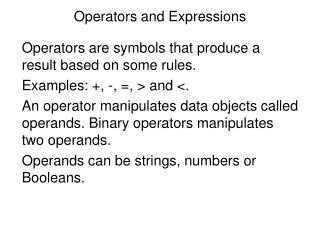
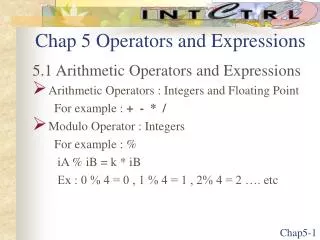
Definition “An operator is a symbol (+, -, *, /) that directs the computer to perform certain mathematical or logical manipulations and is usually used to manipulate data and variables” Ex: a + b
Operators in C • Arithmetic operators • Relational operators • Logical operators • Assignment operators • Increment and decrement operators • Conditional operators • Bitwise operators • Special operators
Logical Operators Logical expression or a compound relational expression- An expression that combines two or more relational expressions Ex: if (a==b && b==c)
Assignment operators Syntax: v op = exp; Where v = variable, op = shorthand assignment operator exp = expression Ex: x = x + 3 x += 3
Increment & Decrement Operators C supports 2 useful operators namely • Increment ++ • Decrement – operators The ++ operator adds a value 1 to the operand The – operator subtracts 1 from the operand ++a or a++ --a or a--
Rules for ++ & -- operators • These require variables as their operands • When postfix either ++ or – is used with the variable in a given expression, the expression is evaluated first and then it is incremented or decremented by one • When prefix either ++ or – is used with the variable in a given expression, it is incremented or decremented by one first and then the expression is evaluated with the new value
Examples for ++ & -- operators Let the value of a =5 and b=++a then a = b =6 Let the value of a = 5 and b=a++ then a =5 but b=6 i.e.: 1. a prefix operator first adds 1 to the operand and then the result is assigned to the variable on the left 2. a postfix operator first assigns the value to the variable on left and then increments the operand.
Conditional operators Syntax: exp1 ? exp2 : exp3 Where exp1, exp2 and exp3 are expressions Working of the ? Operator: Exp1 is evaluated first, if it is nonzero(1/true) then the expression2 is evaluated and this becomes the value of the expression, If exp1 is false(0/zero) exp3 is evaluated and its value becomes the value of the expression Ex: m=2; n=3 r=(m>n) ? m : n;
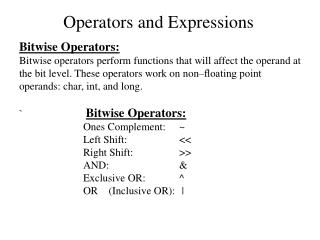
Bitwise operators These operators allow manipulation of data at the bit level
Special operators • Comma operator ( ,) • sizeof operator – sizeof( ) • Pointer operators – ( & and *) • Member selection operators – ( . and ->)
Precedence of operators BODMAS RULE- Brackets of Division Multiplication Addition Subtraction Brackets will have the highest precedence and have to be evaluated first, then comes of , then comes division, multiplication, addition and finally subtraction. C language uses some rules in evaluating the expressions and they r called as precedence rules or sometimes also referred to as hierarchy of operations, with some operators with highest precedence and some with least. The 2 distinct priority levels of arithmetic operators in c are- Highest priority : * / % Lowest priority : + -
Rules for evaluation of expression • First parenthesized sub expression from left to right are evaluated. • If parentheses are nested, the evaluation begins with the innermost sub expression • The precedence rule is applied in determining the order of application of operators in evaluating sub expressions • The associatively rule is applied when 2 or more operators of the same precedence level appear in a sub expression. • Arithmetic expressions are evaluated from left to right using the rules of precedence • When parentheses are used, the expressions within parentheses assume highest priority
Example 1 Evaluate x1=(-b+ sqrt (b*b-4*a*c))/(2*a) @ a=1, b=-5, c=6 =(-(-5)+sqrt((-5)(-5)-4*1*6))/(2*1) =(5 + sqrt((-5)(-5)-4*1*6))/(2*1) =(5 + sqrt(25 -4*1*6))/(2*1) =(5 + sqrt(25 -4*6))/(2*1) =(5 + sqrt(25 -24))/(2*1) =(5 + sqrt(1))/(2*1) =(5 + 1.0)/(2*1) =(6.0)/(2*1) =6.0/2 = 3.0
Example 2 Evaluate the expression when a = 4 B = a- ++a = a – 5 = 5-5 = 0