Download
1 / 117
1.17k likes | 1.3k Vues
This study guide covers essential topics in physiology, focusing on cytoplasmic components, primary tissues, and protein structures. Key questions addressed include the composition of body mass, cellular mechanisms like endocytosis and osmosis, and the classification of tissues. Understanding organelles and their functions, such as cilia and microtubules, is crucial. The guide also explains the characteristics of different solutions impacting cell behavior. Ideal for exam preparation, it provides a systematic approach to mastering chapters 1-5.

E N D
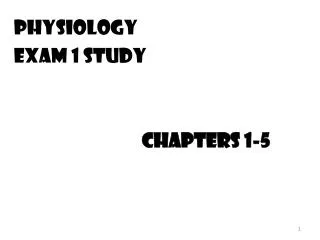
Physiology Exam 1 Study chapters 1-5
The cytoplasm includes all material inside the cell membrane except for_____.
Carbon Hydrogen Oxygen
The alpha helix and pleated sheets are examples of ____ structure proteins.
A sequence of amino acids are examples of ____ structure proteins.
Fibrous proteins (Collagen) and Globular proteins (Hemoglobin) are examples of ____ structure proteins.
A 5M solution of 0.100 mL glucose contains how many grams of glucose? (m.w. of glucose is 180g)
M = #mols of solute L of solution 90g glucose
Cilia Centrioles Microvilli Cytoskeleton Flagella Ribosomes
Epithelial Connective Muscle Neural
Clathrin and Caveolae are used in which process by the cell to bring molecules in to the cytoplasm?
Potocytosis uses caveolae rather than clathrin coated pits to bring molecules into the cell.
What happens to macromolecules that are too large to enter or leave cells through protein channels or carriers?
Cells use two basic mechanisms to import large molecules and particles: phogocytosis and endocytosis.
In osmosis water always moves towards the ___ solution, that is the solution with the ___ concentration of solute.
Hypertonic, Higher
During osmosis, what happens to water once all concentrations are equal?
If a cell is place in solution A and it swells, solution A is ____.
If a cell is place in solution B and it shrinks, solution B is ____.
If a cell is place in solution C and it doesn’t change size, solution C is ____.
The framework of cilia, flagella, centriole, and mitotic spindle is formed by ____.
What cellular specialization causes fluid to flow over the epithelial surface?
What layer of skin protects from bacterial, chemical, and mechanical injuries?
What is the movement of molecules across the cell membrane with the aid of a membrane protein?