Building Competitive Advantage
Strategic Management Essentials, 3/e. Gareth R. Jones | Charles W.L. Hill. Building Competitive Advantage. Chapter 4. Success and Strategy. Within an industry some companies outperform others. What is the basis of their competitive advantage?. Competitive Advantage.

Building Competitive Advantage
E N D
Presentation Transcript
Strategic Management Essentials, 3/e Gareth R. Jones | Charles W.L. Hill Building Competitive Advantage Chapter 4
Success and Strategy • Within an industry some companies outperform others. • What is the basis of their competitive advantage?
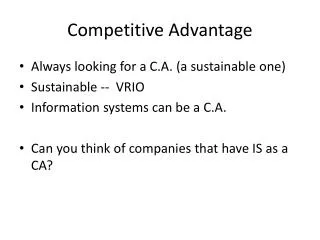
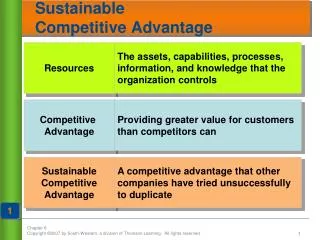
Competitive Advantage • Occurs when a company’s profitability is greater than the industry’s average profitability • Competitive advantage over several years is considered Sustained
Company Profitability Two basic conditions: • Amount of Value that customers place on a good or service • Value creation is at the heart of competitive advantage • The greater the value customers place on a product, the more the company can charge. • A product’s price is usually less than the value placed on it by the average customer. • This causes customers to capture consumer surplus.
Company Profitability (cont’d) • The company’s cost of production • A company will look for ways to increase productivity of capital and labor through: • Economies of Scale • Spread fixed cost over large product volume • Greater division of labor and specialization
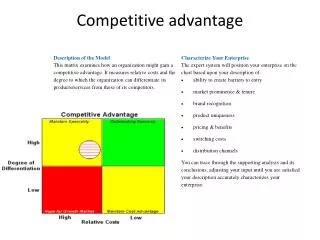
Two Basic Strategies for Creating Value • Low Cost- Drive down cost structure • Differentiation- Consumers value the product and are willing to pay a premium price
Building Competitive Advantage • Four Factors: • Efficiency • Quality • Innovation • Customer Responsiveness • These are the generic building blocks of competitive advantage that any company in any industry can adopt.
Efficiency • Efficiency = outputs/inputs • Employee Productivity: output per employee • Capital Productivity: Output per unit of investment capital • High Productivity = greater efficiency and low costs
Quality as Excellence • Superior Quality: customers perceive attributes of a product to be better than rival’s attributes, including: • Design • Style • Aesthetic appeal • Features and functions • Level of service that comes with the product • Excellence: when excellence is built into product offering, consumers have to pay more to own or consume the product
Quality as Reliability • A product is reliable if it: • Consistently does the job it was designed for • Does the job well • Rarely, if ever, breaks down • Less time is spent of defective products and fixing mistakes • Reliability increases the value a consumer gets from the product and increases the price that the company can charge
Innovation • The act of creating new products or processes • Innovations give a company something unique that their competitors lack • In the long run, innovation is perhaps the most important part of competitive advantage
Innovation (cont’d) • Product Innovation- The development of products that are new to the world or have superior attributes to existing products. • Process Innovation-The development of a new process for producing products and delivering them.
Customer Responsiveness • If a customer’s need is satisfied better by a certain product, the customer will attribute more value to the product. • More value creates a differentiation and ultimately a competitive advantage
The Value Chain • Idea that a company is a chain of activities for transforming inputs into outputs that customers value • Consists of primary and support activities
Primary Activities • Research and Development • Production • Marketing and Sales • Customer Service
Support Activities • Provide inputs for primary activities • Material Management (logistics) • Human Resources • Information Systems • Company Infrastructure
Functional Level Strategies • Managers pursue improvement in business functions by: • Increasing efficiency • Increasing quality • Increasing innovation • Achieving superior customer responsiveness
Distinctive Competencies • A unique firm-specific strength that allows a company to better differentiate or achieve lower cost than rivals • Arise from Resources and Capabilities
Resources • Financial, physical, social or human, technological, and organizational factors that create value to customers. • Can be Tangible or Intangible Example: Tangible = land, building, equipment Intangible = brand names, reputations
Capabilities • A company’s skills at coordinating its resources and putting them into productive use. • Capacities are needed to utilize resources
Durability • When a company has superior profitability, other companies are inclined to imitate the successful strategy. • Durability of competitive advantage depends on the ease or difficulty to copy distinctive competencies. • Barriers of Imitation are thefactors that make copying difficult for competitors. • Even if a company’s distinctive competencies are protected by higher barriers to imitation, it should act as if rivals are continually trying to nullify its source of advantage