Download
1 / 18
190 likes | 312 Vues
This overview explores Woodrow Wilson's Fourteen Points, a peace proposal meant to prevent future wars after World War I. Wilson envisioned a world with arms reduction, self-determination for all peoples, and the formation of the League of Nations. However, the Treaty of Versailles, negotiated by the Big Four, imposed heavy reparations on Germany, leading to further conflict. Despite Wilson's ideals, the U.S. Senate's reservation led to America’s rejection of the League, highlighting the challenges of achieving lasting peace and the complexities of international relations.

E N D
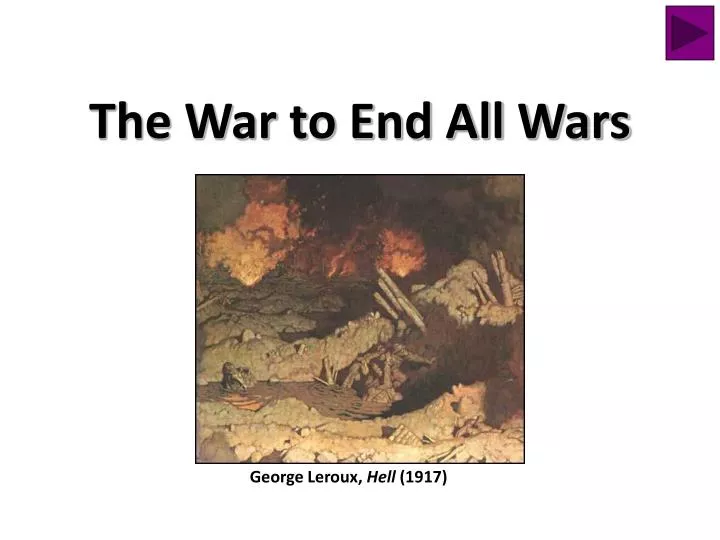
George Leroux, Hell (1917) The War to End All Wars
Wilson’s Fourteen Points • American President, Woodrow Wilson, anticipated the end of the war and hoped to inspire a peace plan that would solve the long-term problems that caused the war. • He drafted a proposal called “The Fourteen Points” • He brought his proposal to France for the treaty conference.
Ideals in Wilson’s Fourteen Points • Arms reduction • No secret treaties • Free and open trade • Self determination (personal independence) of all peoples • Non-punishment • Formation of the League of Nations • Freedom of the Seas
What did Wilson hope the League of Nations would accomplish?
What kind of a welcome did Woodrow Wilson receive, from the citizens, when he arrived in Europe? What view did the leaders of the winning nation have towards him? Were the views/goals of Wilson similar or different than the goals of the leaders of Europe? HOW?
In 1919, the Big 4 met in Paris to negotiate the Treaty(Lloyd George of Great Britain, Orlando of Italy, Clemenceau of France, and Woodrow Wilson of the U.S.)
Treaty of Versailles • Germany forced to pay $32 billion in war reparations. • Germany loses its army and navy. • Germany loses its colonies • Germany accepts guilt for starting the war. • League of Nations created, but Germany not admitted.
“This is not peace. It is an armistice for 20 years.” -Ferdinand Foch What does this mean? Did Germany meet the demands? Why NOT? The League of Nations was too weak to stop it?
The view of the Treaty of Versailles from our Senate. Many, led by Henry Cabot Lodge, had major reservations about signing off on this treaty.
WHY? The U.S. never joined the League !!!
1. U.S. wanted to avoid being forced into foreign entanglements 2. U.S. desired a return to Isolationism. Out of the economic ruins and unsettled differences of World War I comes: “A Stranger in the Desert”