Major Domestic & Foreign Themes in U.S. History: 1960-1974 Review Game
240 likes | 350 Vues
Engage in a collaborative review game designed to explore significant domestic and foreign themes within U.S. history from 1960 to 1974. Working in groups, participants will discuss and answer prompts about pivotal events, figures, and policies, such as the Civil Rights Movement, Vietnam War developments, and the assassination of key leaders. Earn points for correct answers and bonus points based on group performance. This game enhances understanding of historical contexts and promotes teamwork among participants.


Major Domestic & Foreign Themes in U.S. History: 1960-1974 Review Game
E N D
Presentation Transcript
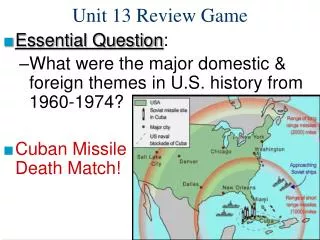
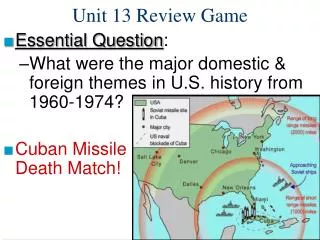
Unit 13 Review Game • Essential Question: • What were the major domestic & foreign themes in U.S. history from 1960-1974? • Cuban Missile Death Match!
Unit 13 Review Game • In groups of three, respond to each prompt presented: • For each series of prompts, groups will earn points per correct answer • For each incorrect answer, groups will earn 0 points • Groups will earn 5, 4, 3, 2, or 1 bonus points based on scores
What Event Caused Each? • The beginning of the civil rights movement in 1954 • The emergence of Martin Luther King as a national civil rights leader in 1955 • March on Washington in 1963 byCORE,SCLC,SNCC,NAACP • Civil Rights Act of 1964 • Voting Rights Act of 1965
Brown v BOE → Civil Rights Movement • Success of the Montgomery Bus Boycott → MLK as leader (& SCLC) • National attention generated by Birmingham march → March on D.C. • Birmingham violence on TV and/or March on D.C. → Civil Rights Act • Violence at Selma march → Voting Rights Act
Identify Each JFK Concept:“Best & the Brightest”“New Frontier”“Flexible Response”Bay of Pigs Warren Commission
“Best & Brightest”: Term for JFK’s White House staff; He increased power of prez by using his staff more than the Cabinet • “New Frontier”: JFK’s domestic policy, called for liberal reform in education, poverty, & strong stand against USSR • “Flexible Response”: JFK’s foreign policy of using a variety of tactics, increased nuclear missiles, CIA, Green Berets • Bay of Pigs: Failed invasion of Cuba 1961 • Warren Commission: Gov’t investigation of JFK’s assassination (“Oswald did it“)
Identify Each Vietnam Concept:Ho Chi MinhNgo Dinh Diem Vietcong Gulf of Tonkin Resolution, 1964Tet Offensive, 1968Pentagon PapersVietnamization
Ho Chi Minh: Communist leader in North • Diem: Democratic leader in South; JFK gave OK for his assassination in 1963 • Vietcong: Communists in the South • Gulf of Tonkin Resolution: Congress gave LBJ all necessary steps to win Vietnam; led to full deployment of U.S. troops • Tet Offensive: Communist invasion into South; showed that USA wasn’t winning • Pentagon Papers: Military docs showed U.S. gov’t was distorting truth about war • Vietnamization: Nixon’s gradual withdrawal of U.S. troops; Let Vietnamese fight
Name 1 way each helped Civil Rights from 1948-1965:Harry TrumanDwight EisenhowerLyndon JohnsonSupreme Court CORESNCC
Truman: Desegregated military in 1948 • Ike: Enforced school integration at Little Rock’s Central High School in 1957 • LBJ: Civil Rights Act of 1964, Voting Rights Act of 1965, 24th Amendment • Supreme Court: Brown v. BOE in 1954 overturned Plessy • CORE: Freedom Rides in 1961 • SNCC: College students inspired by MLK began the sit-in; Later became militant under Stokely Carmichael
Name 5 reasons 1968 was one of the most tumultuous years in American history
Assassination of MLK • Assassination of Robert Kennedy • Student protests in Chicago during Democratic National Convention (Humphrey vs. McCarthy) • Height of the Vietnam War with 500,000 U.S. soldiers deployed • North Vietnam’s Tet Offensive • “Black Power” silent protest at Mexico City Olympics
Name 5 ideas, events, or people associated with “counter-culture” or the “youth movement” of the 1960s & 1970s
Mario Savio, “Free Speech” movement, Students for a Democ Society (SDS) • “Sex, drugs, rock n roll” • Protest of the Vietnam War; Kent State & Jackson State violence in 1970 • Timothy Leary “tune in, turn on, drop out” • Woodstock concert, 1969 • “Hippies” & alternative communities • Any of the “power movements” • Political activism; Dem Convention 1968
Identify Each:DixiecratBlack PowerCivil Rights ActVoting Rights Act Thurgood Marshall Nation of Islam (Black Muslims)
Dixiecrat: Southern Democrats who splintered from the party in opposition to civil rights position of JFK & LBJ • Black Power: led by SNCC & Stokely Carmichael, advocated economic equality with whites; often militant • Civil Rights Act: ended segregation laws • Voting Rights: ended literacy tests & allowed for federal voting registrars • Marshall: Lead NAACP attorney in the Brown case; 1st black Sup.Court justice • Nation of Islam: Led by Malcolm X, advocated a militant, pro-Africa position
Identify Each Civil Rights Concept from 1965-1974: Stonewall RiotERARoe v. Wade La RazaCesar ChavezAlcatraz Island, 1969
Stonewall Riot: Arrests in NY began the gay liberation movement (GLF) • Equal Rights Amnd: failed amendment to end sexual discrimination; Supported by Freidan & Steinem; Opposed by Schlafly • Roe v Wade: Supreme Court upheld abortion rights as a matter of privacy • La Raza: Mexican-American movement dedicated to awareness • Cesar Chavez: Mexican-Am leader of United Farm Workers of America • Alcatraz: Indians of All Tribes seized the prison to bring awareness to Indian rights
Détente: Nixon’s Cold War foreign policy involved: • Easing tensions with USSR • Better relations with China • A gradual withdrawal from Vietnam (Vietnamization)
Identify Each Nixon Concept:“The Great Nixon Turn-Around”“Silent Majority”Ping-Pong DiplomacySALTWar Powers Act (1973)Watergate
Nixon Turn-Around: 90-day freeze on wages helped end a recession in 1971 • Silent Majority: Conservative minded Americans fed up with liberal reform, Cold War foreign policy, & student protests • Ping-Pong Diplomacy: beginning of Nixon’s official recognition of China • SALT: nuclear arms limitation with USSR • War Powers Act:Restrictedmilitarypower of president; Congressional approval to send troops for more than 90 days • Watergate: biggest prez scandal ever