Download
1 / 16
190 likes | 397 Vues
This comprehensive overview explores the significant milestones in cytology and pathology from the discovery of the Pap Smear for cervical cancer diagnosis by Aurel Babes and the development of HPV testing, to the advancements in autopsy techniques by pioneers like Karl Rokitansky. Learn about the evolution of diagnostic practices, the introduction of monoclonal antibodies by Georges Köhler, and the integration of molecular pathology and digital technologies in modern medicine. This historical context highlights the transformative journey of medical diagnostics.

E N D
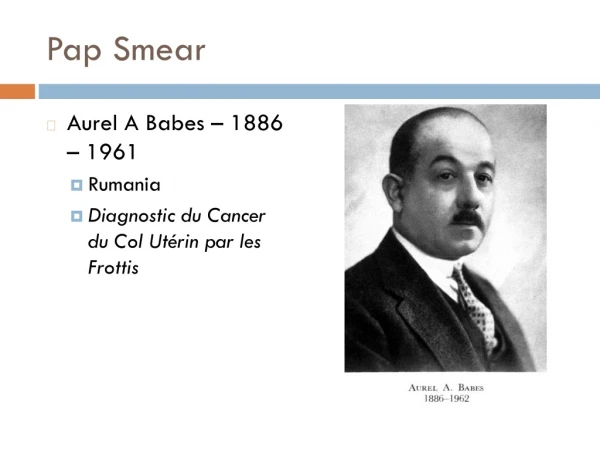
Pap Smear • Aurel A Babes – 1886 – 1961 • Rumania • Diagnostic du Cancer du Col Utérin par les Frottis
Pap Smear • Leopold Koss – Koilocyticatypia • Ernest Ayre – spatula, koilocyticatypia – virus • 1976 – Alexander Meisels, Roger Fortin – HPV • 1983 – HaraldzurHausen – HPV-16, HPV-18 – cervical cancer • 1988 – The Bethesda System • 1996 – Thin Prep • Automated screening • HPV testing
Fine Needle Aspiration Cytology • Hayes Martin and Edward Ellis • Memorial Hospital, New York • Franzén, Zajicek, Löwhagen • Sweden
Special Techniques • Albert Coons – 1912 – 1978 – immuno-fluorescence • Georges Kőhler – 1946 – 1995 – monoclonal antibodies • Kary Mullis – 1944 – PCR
Autopsy • Greek autopsia – to see for oneself • Egypt – mummification • Mesopotamia – examination of liver and entrails of sacrificed animals – hepatoscopy and haruspicy • Greek – battle field wounds • Aristotle – animal dissection
Autopsy • Human dissection – condemned criminals, public • Italian universities, plague victims • Pope Sixtus – 1471 – 1484 – bill permitting dissection • England – grave robbing, Anatomy Act 1832, resurrectionists – William Burke – 1792 – 1829; William Hare – 1792 – 1870, Edinburgh
Rembrandt van Rijn – 1606 – 1669 – The Anatomy Lesson of Dr. NicolaasTulp
Rembrandt van Rijn – 1606 – 1669 – The Anatomy Lesson of Dr. Joan Deyman
Famous Autopsies • King Henri IV – 1610 • King James I – 1625 • Thomas “Old” Parr – 1635 • Claimed to be 152 years old • William Harvey • Napoleon Bonaparte – 1821 • Ludwig van Beethoven – 1827 • Vladimir Lenin – 1924 • John F Kennedy – 1963
“You may take notes for 20 years, from morning to night at the bedside of the sick, upon the diseases of the viscera, and all will be to you only a confusion of symptoms...a train of incoherent phenomena. Open a few bodies and this obscurity will disappear.” • Marie-François-Xavier Bichat – 1771 – 1802 • Father of histology
“Pathological anatomy is the essential basis for pathological physiology, to be supplemented further by pathological histology, chemical pathology, and experimental pathology.” • Karl Rokitansky – 1804 – 1878 • AlgemeinKrankenhaus, Vienna • Father of the modern autopsy • Performed 30,000, supervised 70,000
“To investigate the causes of death, to examine carefully the condition of the organs, after such changes have gone on in them as to render existence impossible and to apply such knowledge to the prevention and treatment of disease, is one of the highest objects of the physician.” • Sir William Osler – 1849 – 1919 • 1,000 autopsies
The Future • Personalized medicine • Molecular pathology – FISH • Digital pathology – Telepathology • Quality assurance, Lean • Gene chip technology
References • Van Den Twell, JG, Taylor CR: A Brief History of Pathology: Preface to a forthcoming series that highlights milestones in the evolution of pathology as a discipline. Virchows Arch, 2010; 457:3-10. • Hajdu, SI: A Note From History: Landmarks in History of Cancer, Part I. Cancer, 2011;117:1097-102. • Hajdu, SI: A Note From History: Landmarks in History of Cancer, Part II. Cancer, 2011;117:2811-20. • Hajdu, SI: A Note From History: Landmarks in History of Cancer, Part III. Cancer, 2011;118:1155-68. • Weiss, L: 2. Early Concepts of Cancer. Cancer and Metastasis Reviews, 2000; 19:205-217. • Diamantis A, Beloukas AI, Katogeraki AM, Magiokinis E: A Brief Chronicle of Cytology: From Janssen to Papanicolaou and Beyond. Diagnostic Cytopathology, 2012; DOI: 10.1002/dc22887. • Hajdu SI, Ehya H: A Note from history: Foundation of Diagnostic Cytology. Annals of Clinical and Laboratory Science, 2008; 38(3):296-299. • Naylor B: The Century for Cytopathology. ActaCytol 2000; 44:709-725. • Weening JJ, Jennette JC: Historical Milestones in Renal Pathology. Virchows Arch, 2012; DOI 10.1007/s00428-012-1254-7. • Burton J: A Bite Into The History of the Autopsy: From Ancient Roots to Modern Decay. Forensic Sci Med Pathol, 2005; 1:4:277. • Wright Jr, JR. Albert C. Broders’ Paradigm Shifts Involving the Prognostication and Definition of Cancer. Arch Pathol Lab Med 2012; 136:1437-1446.