Download

1 / 29
290 likes | 452 Vues
Fungi are vital eukaryotic organisms that display unique characteristics such as heterotrophy, multicellularity, and a distinctive morphology comprised of hyphae and mycelium. They play a crucial role in nutrient cycling as decomposers and form beneficial symbiotic relationships, notably mycorrhizae with plants. Reproducing both sexually and asexually, fungi produce spores that propagate their lifecycle. While they can be pathogenic, leading to significant crop losses, they also offer commercial benefits, including edibles like mushrooms and sources of antibiotics. Understanding fungi is crucial for ecosystem health and agriculture.

E N D
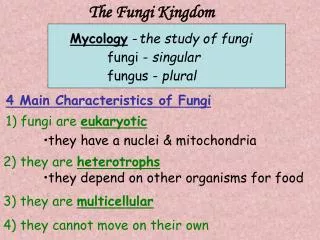
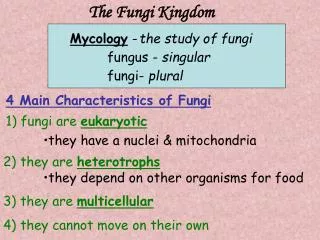
Main features/characteristics: • Heterotrophic saprobes – feed off of decaying material by secreting enzymes to break down into nutrients • parasitic – feed off of living tissues • Cell walls made of chitin (protein that provides shape and support) . . . plant cell walls made of cellulose • Storage molecule made of glycogen, not starch (as is common with plants) • Sessile (stationary) • Multicellular • Eukaryotic
Morphology • Structure made up of strands called hyphae • Collection of hyphae called a mycelium • Multinucleated cells • Cells separated into sections called septa (cytoplasm flows freely between septa)
Life Cycle: • Both sexual and asexual reproduction can occur • Most cells are haploid (one copy of each chromosome) • Spores (reproductive cells) are dispersed • Hyphae grow from spores • Hyphae fuse to form dikaryotic cell (two unique nuclei in one cell) • Mycelium develops into mushroom • Haploid nuclei fuse to form a zygote (now diploid) • Zygote divides into 4 haploid spores • Cycle continues
Nutrient cycling: • main decomposers in ecosystems • Fixation of nutrients into soil and plant roots (symbiosis between plants and fungi = mycorrhizae)
Pathogenic: • 10 to 50% of global produce destroyed yearly by fungi • Toxic growth of materials in buildings • Wood rot
Commercial: • Edible versions of mushrooms and truffles • Cheese, chocolate, soy sauce • Antibiotics (pencillin)
Classification/Phylogeny: Five major phyla
Chytrids (chytridomycota) • Swimming spores (flagellated) • Saprophytic • Single or multicellular
Zygomycetes (zygomycota) • Bread and fruit molds • Soil fungi • Parasitic of insects
Glomeromycetes (Glomeromycota) • Mychorrhizal
Ascomycetes (Ascomycota) • Commercial yeasts • Cup fungi • Plant disease
Basidiomycetes (Basidiomycota) • Gilled mushrooms • Decomposers • Some symbiosis with plants
Mycorrhizae– fungi develop between cell walls of plant roots to deliver nitrogen and extract carbon sugars (mutualism + +)
Lichens – fungi cooperate with cyanobacteria or algae to provide moisture and in return get carbon sugars (mutualism + +)
Leaf cutter ants – harvest leaves to supply food for saprophytic fungi as a food source (mutualism + +)