Linkage Disequilibrium and Polymorphisms at the NPY1R Locus in Diverse Human Populations
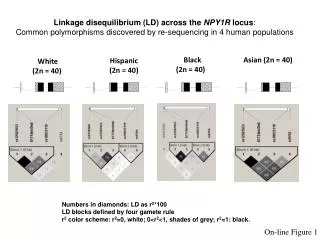
This study investigates linkage disequilibrium (LD) across the NPY1R locus, identifying common polymorphisms via re-sequencing in four human populations: Black, Asian, Hispanic, and White. We present the effects of the A+1050G polymorphism in the NPY1R 3’-UTR on gene expression across different cell lines, including PC12, HEK, and HeLa, observed at 24 hours post-transfection. Sequence alignments reveal the conservation of variants across species, highlighting genetic diversity and evolutionary aspects of the NPY1R locus.

Linkage Disequilibrium and Polymorphisms at the NPY1R Locus in Diverse Human Populations
E N D
Presentation Transcript
Linkage disequilibrium (LD) across the NPY1R locus: Common polymorphisms discovered by re-sequencing in 4 human populations Black (2n = 40) Asian (2n = 40) Hispanic (2n = 40) White (2n = 40) Numbers in diamonds: LD as r2*100 LD blocks defined by four gamete rule r2 color scheme: r2=0, white; 0<r2<1, shades of grey; r2=1: black. On-line Figure 1
On-line Figure 2: NPY1R 3’-UTR polymorphism A+1050G influences gene expression in cella in 3 different cell lines: PC12 chromaffin cells, human embryonic kidney (HEK) cells, and HeLa fibroblasts. Results are shown at 24 h post-transfection. On-line Figure 2
On-line Figure 3A Human variant TCACTTTACCTAGCAGGGAAAAG-TACACAAAAACTGCAGATACT Human wild-type TCACTTTACCTAGCAGGGAAAAA-TACACAAAAACTGCAGATACT Chimp TCACTTTACCTAGCAGGGAAAAA-TACACAAAAACTGCAAATACT Macaca TCACTTCACCTAGCAGGGAAAAAATACACAAAAACTGAGAATACT Conservation ****** *************** ************* ***** 3’-UTR A+1050G On-line Figure 3A Human NPY1R 3’-UTR Variant Inter-species Sequence Alignment. The alignment shown spans 45 bp flanking the polymorphism. The polymorphic base is shown in uppercase bold type. Asterisks (*) indicate that the position is identical in all sequences shown. Sequence alignment by Clustal-W.
On-line Figure 3B:Human NPY1R promoter variant A-585T inter-species sequence alignment. The alignment shown spans 60 bp flanking the polymorphism. The polymorphic base is shown in uppercase bold type. Asterisks (*) indicates that the position is identical in all sequences shown. Sequence alignment by Clustal-W. Human variant GCTAAGCGCTGGGAACAAATCTGACTTATTGCATTTTCTCAGTGGGCCAAAGAAAGGAGG Human wild-type GCTAAGCGCTGGGAACAAATCTGACTTAATGCATTTTCTCAGTGGGCCAAAGAAAGGAGG Chimp GCTAAGCGCTGAGAACAAATCTGACTTAATGCATTTTCTCAGTGGGCCAAAGAAAGGAGG Rhesus ACTTAGCGCTGGGAACAAATCTGACTTAATGCATTTTCTCAGTGGGCCAAAGAAAGGAGG ** ******* **************** ******************************* A-585T On-line Figure 3B