Exploring Obsessive-Compulsive Disorder Through An Evolutionary Psychology Lens
This paper investigates Obsessive-Compulsive Disorder (OCD) from an evolutionary psychology perspective. It explores how OCD symptoms may have once served adaptive functions for survival and examines diverse theories explaining the disorder's presence in modern environments. It discusses Cognitive Behavioral Therapy (CBT) and Exposure and Response Prevention (ERP) as treatment modalities. Additionally, it reviews non-adaptationist approaches, the role of genetic factors, and the implications of evolutionary forces on mental health, aiming to shed light on the complexities of OCD and its historical context.

Exploring Obsessive-Compulsive Disorder Through An Evolutionary Psychology Lens
E N D
Presentation Transcript
OCD in the EEA Katie Bowden Scotty Frazier Elaine Matteucci Melissa Ortiz
Glass, D. J. (2012). Evolutionary clinical psychology, broadly construed: Perspectives on obsessive-compulsive disorder. Journal of Social, Evolutionary, and Cultural Psychology, 6(3), 292-308.
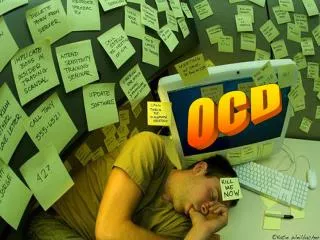
Obsessive Compulsive Disorder • http://www.youtube.com/watch?v=44DCWslbsNM • Anxiety (obsession) and rituals (compulsions)
Treatments for OCD • CBT: Cognitive Behavioral Therapy • ERP: Exposure and response prevention
Possible Evolutionary Forces Accounting for Existence of Mental Disorders • Adaptation: trait shaped by natural selection to solve problems in EEA • Mismatch: once adaptive, but now maladaptive in novel environments • Byproduct: trait is a result of selection of other traits • Balancing selection: trait’s benefits offset its costs in particular environments • Mutation selection balance: minor mutations take longer to be selected against • Lesion
Adaptationism & OCD • Symptoms are related to threat-avoidance and once provided fitness benefits • Meta-cognition of risk scenarios • Benefits for entire group
Non-Adaptationist Evolutionary Approaches • Environmental mismatch theory and mental disorders as normal functioning processes? • Harmful dysfunction defining a true disorder • Aren’t disorders just a by-product of our complex brains and not adaptations of our ancestors? • But then how can evolution and natural selection account for how common, harmful, and heritable these disorders are?
Non-Adaptationist Evolutionary Approaches • Antagonistic pleiotropy: a gene has both harmful and advantageous effects • OCD can serve as a harm-avoidant tendency through balancing selection
Ethological models • Animal models of OCD paralleled with human exemplar • https://www.youtube.com/watch?v=bWjxC0MV8UU • What about the anxiety/obsessive component? • Basal ganglia dysfunction in animals • CBT?
Other Evolutionary Perspectives on Mental Illness • Murphy and Stich: domain-specific modules are malfunctioning • Could explain 4 dimensions of OCD as 4 different neural pathways/domains of functioning • Feygin et al.: 4 domains are threat-avoidance based
Life without any level of OCD symptoms at all? OCD sufferers are one extreme of the polygenetic trait, what about the other extreme?
Evolution as the only perspective • All research domains of biology and psychology are moving towards becoming evolutionary in nature • Does not require strong adaptationism, but might include it
Discussion • The article describes a mental disorder as a harmful dysfunction. Do you think this is accurate? Do you think this qualifies OCD as a mental disorder, in either our modern environment or the EEA?
Discussion • Broadening this evolutionary approach to other abnormal disorders, what possible adaptations could other disorders have provided to our fitness in the EEA? Or are they mostly by-products? How can we be sure?