Volcanoes and Plate Tectonics
170 likes | 321 Vues
This comprehensive overview explores the fundamentals of volcanoes and plate tectonics, detailing the formation of volcanoes at various plate boundaries, including the Ring of Fire. Key concepts such as magma, lava, and the physical and chemical properties of these materials are explained. The text outlines the different types of eruptions (quiet and explosive), volcanic landforms (shield, cinder cone, composite), and geological phenomena such as geysers and hot springs. A study on magma's viscosity and its impact on volcanic activity is also included.


Volcanoes and Plate Tectonics
E N D
Presentation Transcript
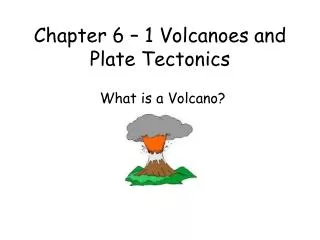
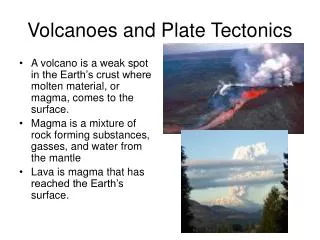
Volcanoes and Plate Tectonics Volcano:a weak spot in the crust where molten material or magma comes to the surface Magma:a molten mixture of rock-forming substances, gases, and water from the mantle Lava:what magma is called when it reaches the surface
Volcanoes at Plate Boundaries • 600 active volcanoes on land • Volcanic belts form along the plate boundaries • One famous volcanic belt is the RING OF FIRE
Volcanoes occur at: • Divergent boundaries • Convergent boundaries Island arc: string of islands created by erupting volcanoes Hot spot: area where material from deep within the mantle rises and then melts • Volcanoes form above hot spots
Mapping Earthquakes and Volcanoes • Google Earth and Catastrophic Events World map • Latitude & Longitude locations given
Properties of Magma Element: a substance that cannot be broken down into other substances - examples: Carbon (C), Hydrogen (H), Oxygen (O) Compound: a substance made of two or more elements that have been chemically combined – examples: water (H2O), carbon dioxide (CO2)
Physical property: any characteristic of a substance that can be observed or measured without changing the composition of the substance. Examples: density, hardness, melting point, smell, freezing point Chemical property: any property that produces a change in the composition of matter. - ability to combine or react with other substances Examples: when burned: changes color, produces a gas, forms new substance
Properties of Magma Viscosity: the resistance of a liquid to flow • High viscosity = slow moving = thick magma • Low viscosity = fast moving = thin magma • The viscosity of magma depends upon its silica content and temperature Silica: compound made of oxygen and silicon • Silica content of magma = 50-70% • more silica = higher viscosity, forms rhyolite rock (similar to granite) • less silica = lower viscosity, forms basalt rock
Types of lava Pahoehoe: fast moving, hot lava that has a low viscosity • Looks like a whole bunch of wrinkles Aa: slow moving, high viscosity lava • Looks like large lava chunks puffed up • Which type am I?
Parts of a Volcano Magma chamber: located underneath the volcano where the magma collects Pipe: a long tube in the ground that connects the magma chamber to the earth’s surface Vent: the opening in the volcano where molten gas and rock are expelled Lava flow: area covered by lava as it pours out of the vent Crater: bowl-shaped area that forms on top of the volcano located around the central vent *Tell students volcano diagram page #, quiz to follow on Tuesday
http://egsc.usgs.gov/isb/pubs/teachers-packets/volcanoes/poster/poster.htmlhttp://egsc.usgs.gov/isb/pubs/teachers-packets/volcanoes/poster/poster.html • http://www.brainpop.com/science/earthsystem/volcanoes/
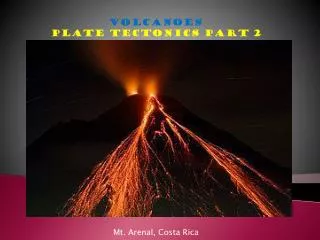
Types of Eruptions Quiet Eruption: eruption where magma is low in silica and has a low viscosity • Lava flows quietly from the vent and can flow for many kilometers Shhhhh… the volcano is erupting!
Explosive Eruption: eruption where magma has a high silica content and viscosity • Magma can flow out of the crater or build up in the volcano’s pipe until it explodes (think of cork getting stuck in a bottle) • Produces bombs and cinders Pyroclasic flow: mixture of hot gases, ash, cinders, and bombs
Life Cycle of a Volcano • Active: volcano that is erupting or has shown signs that it may erupt in the near future • Dormant:volcano that is expected to awaken in the future and become active • Extinct: volcano considered to be dead and is unlikely to erupt again Aerial view of volcano
Volcanic Landforms Shield Volcanoes: quiet eruptions that gradually build up a gently sloping mountain Cinder Cone Volcanoes: explosive eruptions that creates a cone-shaped hill from ashes, cinders and bombs building up around the vent Composite Volcanoes: cone shaped mountains formed from layers of lava and ash from quiet and explosive eruptions
Lava Plateaus: made up of many layers of thin runny lava that erupt from long cracks in the ground Calderas: massive hole left by the collapse of a volcano. • Read page 102 to see how they form
Landforms from Magma Volcanic Necks: forms when magma hardens in a volcanoes neck – looks like a giant tooth Batholiths: rock formed when a large body of magma cools inside the crust • Read pages 103 - 104
Geothermal Activity Hot Springs: forms when groundwater is heated by a nearby body of magma or by hot rock deep underground Geyers: fountain water and steam that erupts from the ground Geothermal Energy: using water heated by magma to provide energy (pipes, turbine generator)