Understanding and Balancing Chemical Equations: A Step-by-Step Guide
Balancing chemical equations is crucial for understanding chemical reactions, as it ensures that mass is conserved. This guide explains the process of balancing equations, starting with writing a skeleton equation and using coefficients to achieve balance without altering subscripts. It emphasizes the importance of recognizing diatomic atoms (H₂, O₂, N₂, etc.) and provides examples such as H₂ + O₂ → H₂O and AgNO₃ + H₂S → Ag₂S + HNO₃. Master this skill to excel in chemistry!

Understanding and Balancing Chemical Equations: A Step-by-Step Guide
E N D
Presentation Transcript
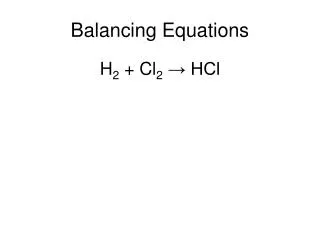
Balanced Equation • A chemical equation in which both sides have the SAME # of ATOMS • Remember from Dalton that mass must be conserved! • Atoms are rearranged in a chemical reaction
Steps for Balancing Equations: • Write skeleton equation • Use coefficents to balance the equation NEVER, EVER change subscripts….EVER!!! • Recheck…should be in lowest ratio
Diatomic Atoms - HONClBrIF • Atoms that covalently bond with themselves • You need to know these for balancing equations!
Example H2 + O2 → H2O # H: # O:
More Examples: AgNO3 + H2S → Ag2S + HNO3 Zn(OH)2 + H3PO4 → Zn3(PO4) 2 + H2O hydrogen + sulfur → hydrogen sulfide iron (III) chloride + calcium hydroxide → iron (III) hydroxide + calcium chloride