Balancing Equations
This guide outlines the principles of balancing chemical equations, emphasizing the conservation of mass and the necessity to have equal numbers of each type of atom on both sides. It introduces key concepts such as chemical formulas, coefficients, and the importance of not altering the formulas. Through a practical analogy with a pancake recipe, the necessity of precise ingredient ratios is illustrated. The guide also provides examples of balancing equations using coefficients to achieve a balanced state, demonstrating the process step-by-step with familiar chemical reactions.

Balancing Equations
E N D
Presentation Transcript
Recall • Formula: The symbolic representation of a chemical compound. NaCl, H2O. • Equation: The symbolic representation of a chemical reaction. • We combine Ions to create formulae. • We use the formulae to write the equation.
Balancing • If mass is conserved and atoms can not be created or destroyed in a chemical reaction. • Our equations should show the same number of each kind of atom on both sides of the equation. • The equation must balance.
Balancing Rules • Always show the correct chemical formulae of all substances involved in the reaction. You are not allowed to balance an equation by changing a formula! • Adjust the numbers of each kind of atom by writing numbers in front of the formulae of the compounds and elements. These numbers are known as coefficients.
Real Life Example. • A Recipe for Pancakes. • In my recipe for pancakes it requires 1 cup milk 2 eggs 1 cup flower The 1, 2 and 1 are the Coefficients. You can not make the pancakes with just the egg whites or the yolks. That would be changing the formula.
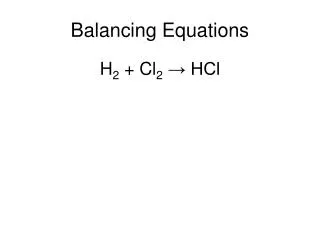
H2O => H2 + O2 How many H’s on the left? 2 How many H’s on the right? 2 2 = 2 H’s are balanced. H2O => H2 + O2 How many O’s on the left? 1 How many O’s on the right? 2 1 ≠ 2 O’s are not balanced. Lets Try
The Answer • H2O => H2 + O2 • We can only adjust Coefficients. • Right now all Coefficients are 1 • There is 1 O on the left and 2 on the right • We add a coefficient of 2 on the left. • 2H2O => H2 + O2This fixes the O’s but messes up the H’s. • We fix with a coefficient of 2 on the right • 2H2O => 2H2 + O2 • Now all elements balance. So does the equation.
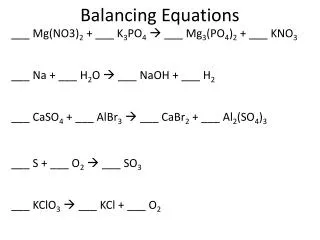
Try These • Na + Cl2 => NaCl • 2Na + Cl2 => 2NaCl Balanced. • CdS + HCl => CdCl2 + H2S • CdS + 2HCl => CdCl2 + H2S • Fe + H20 => Fe2O3 + H2 • 2Fe + 3H20 => Fe2O3 + 3H2
You Try • Balancing Equations #1 • Balance with coefficients #’s 1 to 16 • #’s 17 to 20, use ions to create the formulae then balance. • Due tomorrow.