Understanding Wireless Sensor Networks: Engineering Issues and Communication Concepts
This document introduces foundational concepts of Wireless Sensor Networks (WSNs), exploring various engineering issues such as interfaces, data communication between Motive and MCU, and relevant sensors for temperature and humidity applications. It outlines critical aspects related to reliability and stability in consumer, industrial, automotive, and military contexts. The significance of both Data Terminal Equipment (DTE) and Data Circuit-terminating Equipment (DCE), along with essential data flow control mechanisms such as handshaking and serial communications standards, is also discussed, providing a comprehensive overview for engineering students.

Understanding Wireless Sensor Networks: Engineering Issues and Communication Concepts
E N D
Presentation Transcript
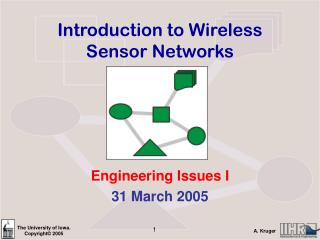
Introduction to Wireless Sensor Networks Engineering Issues I 31 March 2005
Organizational Class Website www.engineering.uiowa.edu/~ece195/2005/ Class Time Office Hours
Issues • Interfaces • Mote/MCU <-> radio(s) • Mote/MCU <-> Sensors • Programming mote • Temperature & Humidity • Impacts reliability, packaging, stability, • Consumer (0 … 70o) • Industrial (-40 … +85o) • Automotive, Military • Packaging • Reliability • Consumer, Medical
Concept DTE/DCE • DTE (The device that generates or requests data) • MCU • Datalogger • PC • Terminal emulator • Mote • DCE (The devices that interfaces with the media) • Modem • Radio • Instruments • GPS • Important DTE and DCE data rates may differ. Often DTE <-> DCE data rates are larger than data rates between DCEs
Concept: Data Rates and Flow Control • DTE<-> DCE data rates may exceed DEC<-> DCE rates • DCE has internal buffers • When buffer is close to full DCE signals DTE to stop sending data • When DEC buffer becomes empty, it signals DTE that it can start sending data
Concept: Handshaking • DTE uses a “Request To Send” (RTS) signal to let DCE know its want to send data • DCE uses a “Clear To Send” (CTS) to signal it is ready to send or not • Sleep modes • RTS are sometimes used to wake sleeping DCEs
Serial Communications • RS232/RS232C,RS422, RS485 or TTL Levels • USB, USB <-> RS232 adapters • DB9, DB25, Two-wire, I2C, SPI • Data lines • TX or TD : data is transmitted to a DCE (out from PC) • RX or RD : data is received from DCE (into PC) • Control Lines • Hardware Flow Control • RTS (Request To Send). DTE (PC) uses this to inform DCE that it wants to send data • CTS (Clear To Send) DCE (modem/radio) uses this to inform DTE (PC) when it is clear to send or not • CD (Carrier Detect) • DTR (Data Terminal Ready) – similar to RTS • Software Flow Control – special codes in the data stream (XON/XOFF)
Command vs. Data Mode – AT Commands • Sending Data & Commands over a serial link • Data (normal) mode • Command (configuration) mode • Switch between modes with a special sequence delay +++ delay • Issue AT commands ATDT … • Switch Back ATCN
Serial Communications Misc • Cable Lengths • Null Modems • Gender Changers • Loop-back adapters • Break-out boxes • Cable testers • RS232 <-> TTL converters • Gotcha’s (not all DB9 cables are RS232) • UPS cables • Some instrument cables
Null Modem Cont. Full Handshaking Loop back handshaking
Applications • Echo Server • Streaming Server
Lab Next Week • Two-three hours • Groups of three students work as a team • Individual reports • Signup sheet • Wednesday afternoon • Thursday afternoon • Friday afternoon • Saturday? • Preparation • Will post and e-mail