
Bridge Pattern: Decoupling Abstraction and Implementation
E N D
Presentation Transcript
Bridge Pattern by Robert Smith Feb 23, 2009
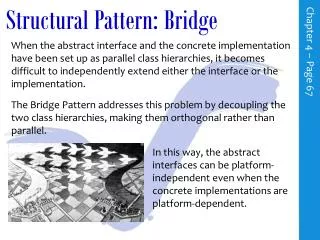
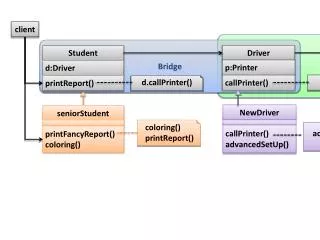
Context • The normal method of dealing with an abstraction having several implementations is through inheritance. • However, this permanently binds the implementation to the abstraction. • This is not always flexible enough. You may want to modify or extend the abstraction or implementations independently. • The Bridge Pattern decouples an abstraction from its implementation.
Applicability • Selection or switching of implementation is at run-time rather than design time. • Abstraction and implementation should both be extensible by subclassing. • You want to isolate implementation changes from clients. • You want to share an implementation among multiple objects and this should be hidden from the client.
Pattern Structure bridge
A Meal Example bridge
Code – 1 of 1 (Abstraction) public class Meal { protected MealImp imp; public Meal() { imp = new AmericanMealImp(); } public Meal(String type) { if (type.equals("American")) imp = new AmericanMealImp(); if (type.equals("Italian")) imp = new ItalianMealImp(); if (type.equals("French")) imp = new FrenchMealImp(); } public void getFirstCourse() { imp.getAppetizer(); } public void getSecondCourse() { imp.getMeat(); } public void getBeverage() { imp.getBeverage(); } public void getDessert() { imp.getDessert(); } } public class Snack extends Meal { public void getSnack() { imp.getAppetizer(); } } public class Lunch extends Meal { public void getLunch() { imp.getSandwich(); imp.getBeverage(); } } public class FiveCourseMeal extends Meal { public void getEnormousDinner() { imp.getAppetizer(); imp.getSorbet(); imp.getSoup(); imp.getSorbet(); imp.getSalad(); imp.getSorbet(); imp.getFish(); imp.getSorbet(); imp.getMeat(); imp.getSorbet(); imp.getCheesePlate(); imp.getDessert(); imp.getBeverage(); } }
Code – 2 of 2 (Implementor) public interface MealImp { public abstract void getAppetizer(); public abstract void getSoup(); public abstract void getSalad(); public abstract void getFish(); public abstract void getMeat(); public abstract void getPasta(); public abstract void getCheesePlate(); public abstract void getBeverage(); public abstract void getDessert(); public abstract void getSorbet(); public abstract void getSandwich(); } public class ItalianMealImp implements MealImp { public void getAppetizer() { System.out.println("Appetizer: anti pasti"); } public void getSoup() {} public void getSalad() {} public void getFish() {} public void getMeat() { System.out.println("Meat: chicken piccata"); } public void getPasta() {} public void getCheesePlate() {} public void getBeverage() { System.out.println("Beverage: cappuccino"); } public void getDessert() { System.out.println("Dessert: gelato"); } public void getSorbet() {} public void getSandwich() {} } public class AmericanMealImp implements MealImp { public void getAppetizer() { System.out.println("Appetizer: nachos"); } public void getSoup() {} public void getSalad() {} public void getFish() {} public void getMeat() { System.out.println("Meat: steak"); } public void getPasta() {} public void getCheesePlate() {} public void getBeverage() { System.out.println("Beverage: beer"); } public void getDessert() { System.out.println("Dessert: apple pie"); } public void getSorbet() {} public void getSandwich() {} } public class FrenchMealImp implements MealImp { public void getAppetizer() { System.out.println("Appetizer: escargot"); } public void getSoup() {} public void getSalad() {} public void getFish() {} public void getMeat() { System.out.println("Meat: coq au vin"); } public void getPasta() {} public void getCheesePlate() {} public void getBeverage() { System.out.println("Beverage: bordeaux"); } public void getDessert() { System.out.println("Dessert: creme brulee"); } public void getSorbet() {} public void getSandwich() {} }
Code – 3 of 3 (Client) public class Customer { private Meal meal; public Customer(Meal aMeal) { meal = aMeal; } public void eat() { meal.getFirstCourse(); meal.getSecondCourse(); meal.getBeverage(); meal.getDessert(); } public static void main(String[] args) { Meal aMeal = null; // Read the input to see if we do American, Italian or French if (args.length == 0) { // create default Meal aMeal = new Meal(); } else if (args.length == 1) { // see if arg is NOT American, Italian or French if (!(args[0].equals("American")) && !(args[0].equals("Italian")) && !(args[0].equals("French"))) { System.err.println("1 arg given but not recognized"); System.err.println("usage: java Customer [American|Italian|French]"); System.exit(1); } else { aMeal = new Meal(args[0]); } } else { // error System.err.println("wrong number of args"); System.err.println("usage: java Customer [American|Italian|French]"); System.exit(1); } Customer c = new Customer(aMeal); c.eat(); } }
Code - Results Bob@Bob-XPS ~/cspp51023/Bridge Pattern $ java Customer American Appetizer: nachos Meat: steak Beverage: beer Dessert: apple pie Bob@Bob-XPS ~/cspp51023/Bridge Pattern $ java Customer Italian Appetizer: anti pasti Meat: chicken piccata Beverage: cappuccino Dessert: gelato Bob@Bob-XPS ~/cspp51023/Bridge Pattern $ java Customer French Appetizer: escargot Meat: coq au vin Beverage: bordeaux Dessert: creme brulee Bob@Bob-XPS ~/cspp51023/Bridge Pattern $
Consequences • Decouples interface and implementation. • Eliminates compile-time dependencies. • Improved extensibility. • Hiding implementation details from client.
Implementation Considerations • Only one Implementor • Multiple implementors not always needed. • Separation is still useful even in this degenerate case to hide implementation changes from clients. • Creating correct Implementor • Instantiate in constructor based on parameters. • Use default implementation and possibly change later. • Use AbstractFactory. • Sharing Implementors • Use a reference count in the implementation to know when an instance is being used.
Related Patterns Abstract Factory - Used to create the Implementor and remove all knowledge of which one from the Abstraction. Adapter – Used to make 2 unrelated classes work together. Usually applied after system is designed. Bridge does similar work but is done up front during design.