
Communication Process
E N D
Presentation Transcript
Section 22.1 Communication Basics
Objectives After completing this section, you will be able to • describe the six elements of the communication process. • explain barriers to effective communication.
Key Terms communication process sender encoding transmission channel receiver decoding feedback barrier diversity multicultural society multigenerational sending barrier receiving barrier
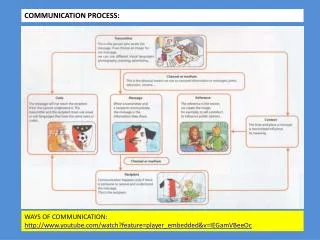
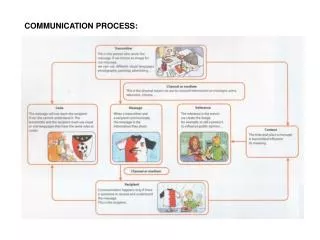
What Is Communication? • Communication is the process of sending and receiving messages that convey information, ideas, feelings, and beliefs • The communication process is a series of actions on the part of the sender and the receiver of the message on the path a message follows • The communication process has six elements: sender, message, channel, receiver, translation, and feedback
What Is Communication? (Continued) • The sender is the person who has a message to communicate • The message is what is being sent by the sender • What do you want to communicate? • How do you want to communicate? • Encoding is the process of turning the idea for a message into symbols that are communicated to others • The act of sending of a message is called transmission, and the channel is how the message is transmitted, such as face-to-face conversation, telephone, e-mail, text, or any other vehicle
What Is Communication? (Continued) • The receiver is the person who gets a message • Decoding is translating the message into terms that the receiver can understand • The process of understanding a message • Only received when receiver understands it • Feedback is the response of the receiver to a message, and it concludes the communication cycle
Barriers to Effective Communication • Barriers are anything that prevents clear, effective communication • May occur in written, verbal, and nonverbal communications • Diversity means having people in a group or organization who are of different races or who have different cultures; markets are diverse • When people come together in the workplace, a variety of communication barriers may arise • Multicultural society is a society consisting of people from many cultures with many different wants and needs
Barriers to Effective Communication(Continued) • Communicating in different languages can present a language barrier, especially when doing business internationally • Multigenerational describes people of different generations in the same place, such as living or working together in the same home or office • The six steps in the communication process can create potential barriers for a sender, receiver, or both
Barriers to Effective Communication(Continued) • Sending barriers: the sender says or does things that cause the receiver to tune out the message • Unfamiliar words, poor grammar, or assumptions of certain knowledge may be wrong • Sender must make sure the message is clear to the receiver and is understood • Receiving barriers: the receiver says or does things that cause a message to not be received as intended
Effective Communication Goodheart-Willcox Publisher
Section 22.2 Types of Communication
Objectives After completing this section, you will be able to • explain the importance of written communication skills. • describe verbal communication skills that are important in the workplace. • identify the role nonverbal communication plays in marketing.
Key Terms written communication writing process four Cs of writing memo report verbal communication telephone etiquette nonverbal communication body language
Written Communication • Written communication is recording words through writing or keying to communicate • Many decisions must be made when developing a written marketing message • Words chosen depend on the target market, the purpose of the message, and the desired response from the receivers • Very few images are strong enough to carry a marketing message without any words
Written Communication (Continued) • Writing process is a set of sequential stages for each writing task; in marketing, it is • Prewriting: define customer profile and message intent • Writing: create message draft; revise as needed • Post writing: get feedback and proofread final • Publishing: print or send document electronically • Use the four Cs of writing: clear, concise, courteous, and correct communication
Written Communication (Continued) • Marketing promotions include print advertising pieces, items for sales promotion, press releases, media kits, sales brochures, faxes, and scripts for personal selling • Business correspondence includes letters on company letterhead, internal memos, and formal or informal reports
Written Communication (Continued) Goodheart-Willcox Publisher
Verbal Communication • Verbal communication is speaking • Marketers are expected to have both good written and verbal communicating skills • Tone of speech refers to the feeling conveyed to the receiver from the way words are spoken • Verbal communication tips • Use Standard English, speak clearly, make eye contact, ask relevant questions, use friendly tone • Eliminate distracting physical habits
Verbal Communication (Continued) • Good telephone etiquette, or using good manners on the telephone, is important • Telephone skill tips • Smile when answering phone, speak clearly and in a normal tone, and use the company greeting • When making calls, plan messages in advance; have paper and pen for taking messages or notes • A presentation is a formal speech that presents information to the receivers; goal is often to persuade the audience
Nonverbal Communication • Nonverbal communication refers to actions, as opposed to words, that send messages • Body language is nonverbal communication through facial expressions, gestures, body movements, and body position • Nonverbal communication barriers can include • Distracting mannerisms • Facial expressions that conflict with the words spoken • Inappropriate dress or conduct • Sarcastic or angry tone of voice • Speaking too softly or too loudly
Section 22.3 Listening and Reading with a Purpose
Objectives After completing this section, you will be able to • discuss listening skills and why they are important to marketers. • explain what it means to read with a purpose.
Key Terms active listening passive listening empathy prejudice active reading skimming scanning reading for detail
Listening Skills • Hearing is a physical process; listening is an intellectual process that combines hearing with evaluation • Active listening takes place when the listener is focused on what is being said • Passive listening takes place when the listener hears the message but does not pay attention to what is being said; types include careless, distracted, narrow, and defensive listeners
Listening Skills (Continued) • Successful marketers know how to listen to customers and vendors and interpret the communication • Two important listening skills to learn are • Showing empathy, the process of seeing things from the point of view of another person • Overcoming barriers to listening
Listening Skills (Continued) • Barriers to listening • Interruptions can come from anyone during a conversation • Assumptions that people know what a speaker will say • Prejudice is a feeling of like or dislike for someone, especially when it is not reasonable or logical • Planning a response while the speaker is still speaking
Reading with Purpose • Reading is one of the main ways to learn new information • Marketers read research documents, business e mails, various reports, and many promotional pieces • Active reading takes place when the reader is thinking about what he or she is reading
Reading with Purpose (Continued) • Have a clear purpose for what is being read • Skimming is quickly glancing over the entire document to identify the main ideas • Scanning is moving the eyes quickly down the page to find specific words and phrases • Reading for detail involves reading all of the words and phrases and considering the meanings
Review • Where does decoding occur? Answer: Decoding occurs in the mind of the receiver. • What are the four common types of interference that can occur at work? Answer: These include interruptions, assumptions, prejudice, and planning a response.