

SlideServe
Menu
Préférences
© SlideServe · v2026

Infantile Cataract

shubha avatar
11 diapositives · 870 Views · Oct 08, 2014

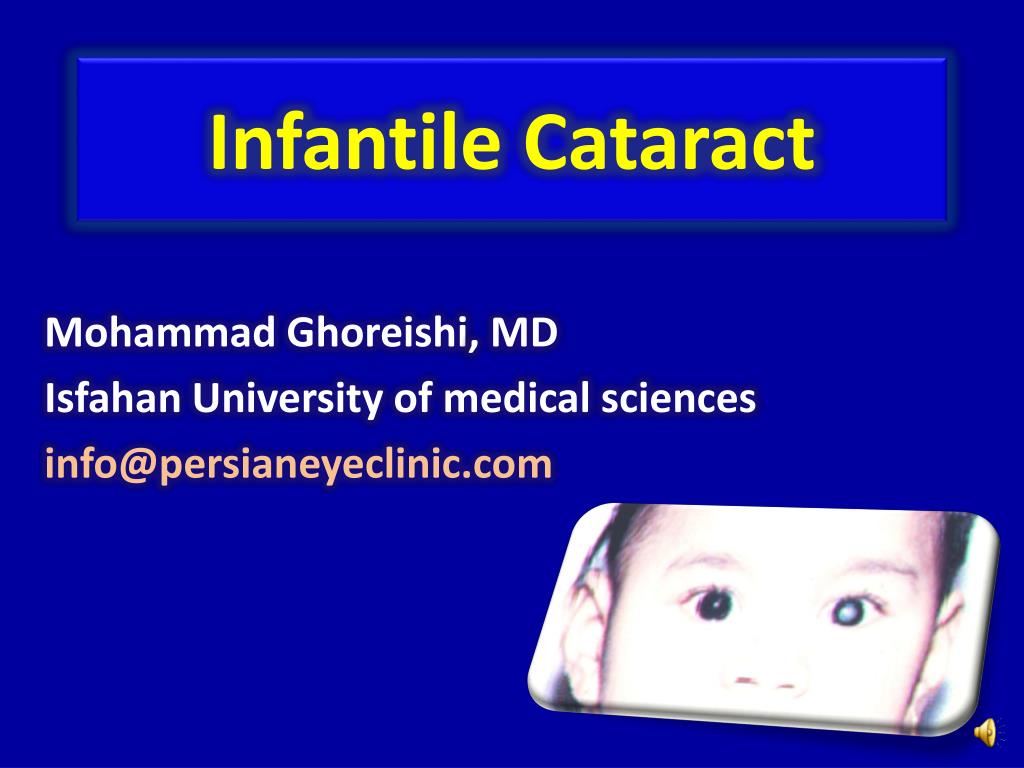
Infantile Cataract. Mohammad Ghoreishi , MD Isfahan University of medical sciences info@persianeyeclinic.com. Infantile cataract. Congenital Present at birth Hereditary Non-hereditary Developmental Progression or development over time Acquired Unilateral or bilateral.
Infantile Cataract - slide 1
01 / 11Infantile Cataract
1 / 17

Télécharger la présentation

Infantile Cataract
Une image / un lien ci-dessous est fourni (tel quel) pour télécharger la présentation

Politique de téléchargement : le contenu du site vous est fourni TEL QUEL pour votre information et votre usage personnel ; il ne peut être vendu, concédé sous licence ni partagé sur d’autres sites sans l’accord de son auteur.Le contenu vous est fourni TEL QUEL, pour votre information et votre usage personnel uniquement. Téléchargez la présentation en cliquant sur ce lien. Lors du téléchargement, si vous ne parvenez pas à télécharger une présentation, l’éditeur a peut-être supprimé le fichier de son serveur.Pendant le téléchargement, si vous ne parvenez pas à obtenir une présentation, le fichier a peut-être été supprimé par l’éditeur.

F I N

Plus de contenu associé

Transcription de la présentation
  1. Infantile Cataract Mohammad Ghoreishi, MD Isfahan University of medical sciences info@persianeyeclinic.com

  2. Infantile cataract • Congenital • Present at birth • Hereditary • Non-hereditary • Developmental • Progression or development over time • Acquired • Unilateral or bilateral

  3. Etiologies, bilateral • Sporadic, not associated with any systemic or ocular diseases • Hereditary and familial • Intrauterine infections, especially “TORCH” • Metabolic disorders • Genetically transmitted syndromes Congenital Rubella Syndrome (CRS)

  4. Etiologies, unilateral • Usually isolated sporadic incidents • Associated with ocular abnormalities • Posterior lenticonus • Persistent hyperplastic primary vitreous (PHPV) • Anterior segment dysgenesis • Posterior pole tumors • Trauma • Intrauterine infection, particularly rubella. PHPV

  5. In our experience the following etiologies are frequently overlooked, they need high index of suspicion: • Galactosemia • Hypocalcemia • Diabetes • TORCH Early galactosemic cataract

  6. Leukocoria(white pupil) Differential diagnosis: • Retinoblastoma • congenital cataract • PHPV (persistent hyperplasia of primary vitreous) • Retina detachment (trauma/ retinopathy of prematurity) • Toxocariasis (nematode infection) from exposure to puppies • Uveitis, infections, other conditions It is recomended to check red reflex of all neonates & children www.occhioallaretina.it/Immagini/leucocoria.JPG

  7. Location of the opacity • Anterior polar • Anterior subcapsular • Cortical • Sutural • Lamellar (zonular)

  8. Location of the opacity • Nuclear • Posterior subcapsular • Posterior polar • Posterior lenticonus • Total

  9. Cause of visual loss • Lens opacity • Cataracts in the center of the visual axis that are greater than 3 mm in diameter are generally considered visually significant • Refractive error and anisometropia

  10. Progression • Static cataract • Anterior polar • Nuclear • Progressive cataracts • Posterior lenticonus • Persistent hyperplastic primary vitreous, • lamellar, sutural, and anterior or posterior subcapsular. • They usually have a better prognosis because they only usually begin to obstruct the vision after the critical period of visual development has passed.

  11. ضمن عرض پوزش بدلیل حجم بالای LECTUER ادامه اسلایدها امکان پذیر نمیباشد در صورت نیاز به ادامه لطفا به واحد سمعی و بصری مرکز آموزشی درمانی فیض مراجعه و یا با شماره تلفن 03114476010 داخلی 392تماس حاصل نمائید با تشکر