Advanced Sequential Extraction Techniques for Mineral Analysis in Soil and Crust Samples
This document summarizes wet chemical procedures used for sequential extraction of mineral species from complex matrices. The methods focus on selectively removing compounds using progressively stronger reagents, accommodating diverse sample chemistries. Examples include the analysis of hydrated iron sulfate minerals from the Henryville bed and the sequential extraction of heavy metals from Bloomington soil. This comprehensive approach facilitates understanding of metal distribution and potential environmental impacts through detailed fractionation techniques.

Advanced Sequential Extraction Techniques for Mineral Analysis in Soil and Crust Samples
E N D
Presentation Transcript
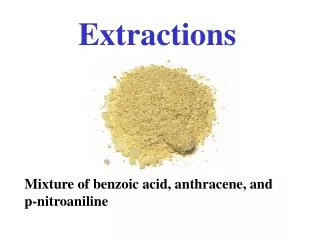
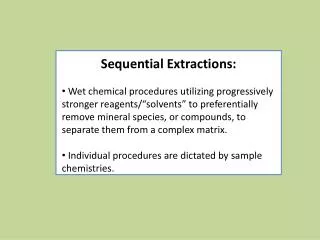
Sequential Extractions: • Wet chemical procedures utilizing progressively stronger reagents/“solvents” to preferentially remove mineral species, or compounds, to separate them from a complex matrix. • Individual procedures are dictated by sample chemistries.
Weathering crusts forming on the Henryville bed (HEN-2). (photo: Nelson Shafer, IGS) Example 1: Copiapites: a hydrated iron sulfate mineral with a formula: Fe2+Fe3+4(SO4)6(OH)2·20(H2O) X-ray Diffraction (XRD) 10 cm Zc Ac Zc Ac G Zc G Ac A A G G A Q
in 250 ml glass beaker 1-9 g, dry sulfate crust, homogenized stirred for 24 hours, at 70oC, filtered with 0.8µm cellulose nitrate filter, supernatant reserved, residue subtracted from initial mass 100 ml 1.0N HCl supernatant transferred to a 100 ml volumetric flask and filled to volume de-ionized H2O 10 ml supernatant transferred back to 250 ml beaker and NaOH pellets added to remove Fe-hydroxides. Sample filtered, Fe-hydroxides discarded. BaCl2added to supernatant to precipitate BaSO4 90 ml supernatant reserved for AAS metals analysis 10 ml 0.5M BaCl2 0.02% HNO3
Example 2: Bloomington Soil Pb 34000 32000 house paint road
in 50 ml centrifuge tube 2 g, dry soil, homogenized 25 ml 0.5M KNO3 stirred for 16 hours, centrifuged, filtered with Whatman#42 filter, supernatant reserved for analysis Exchangeable Fraction stirred for 2 hours, centrifuged, filtered, supernatant reserved for analysis 25 ml distilled H2O Absorbed Fraction Organically-Bound Fraction 25 ml 0.5M NaOH stirred for 16-21 hours, centrifuged, filtered, supernatant reserved for analysis stirred for 6 hours, centrifuged, filtered, supernatant reserved for analysis Carbonate-Bound Fraction 25 ml 0.05M Na-EDTA heated (70-80oC) for 16-21 hours in an oven, centrifuged, filtered, supernatant reserved for analysis 25 ml 4.0M HNO3 Residual Fraction Sposito, G., Lund, L.J., and Chang, A.C., 1982, Trace Metal chemistry in arid-zone field soils amended with sewage sludge: I. Fractionation of Ni, Cu, Zn, Cd, and Pb in solid phases: SSSA Journal, 46:260-264.
Alva, A.K., Huang, B., Paramasivam, S., 2000, Soil pH affects copper fractionation and Phytotoxicity: Soil Science Society of America Proceedings, 29:955-962.
Bruchert, V., 1998, Early diagenesis of sulfur in estuarine sediments: the role of sedimentary humic and fulvic acids: Geochimica et CosmochemicaActa, 62:1567-1586.
Chao, T.T., and Theobald, Jr., P.K., 1976, The significance of Secondary Iron and Manganese Oxides in Geochemical Exploration: Economic Geology, 71:1560-1569.
Li, X., Coles, B.J., Ramsey, M.H., Thornton, I., 1995, Sequential extraction of soils for multielement analysis by ICP-AES: Chemical Geology, 124:109-123. (N. Atlantic seafloor manganese nodules )