Neurological Disorders: Motor Neuron Disease & Multiple Sclerosis
370 likes | 461 Vues
Learn about motor neuron disease, its degenerative nature, symptoms, diagnosis, and treatments alongside insights into multiple sclerosis, its epidemiology, risk factors, clinical presentations, diagnosis, and differential considerations.


Neurological Disorders: Motor Neuron Disease & Multiple Sclerosis
E N D
Presentation Transcript
Motor neuron disease is degenerative disease which selectively affect motor tract fibers (corticospinal tract+ anterior horn cell) UMN signs LMN signs Motor neuron disease
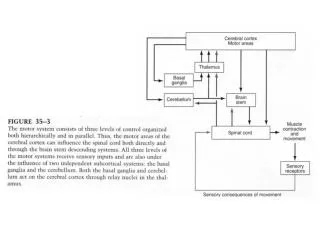
Motor pathway • cortex motor area • Corticospinal fiber & corticobulber • AHC motor neuron disease • Peripheral nerves • NMJ • muscle
pathology • Degeneration of the neurons
path physiology • Sporadic:90% unclear • Inherted:10% familial ALS,25% mutation in gene encoding copper zinc super oxide dismutase (SOD1)
course • Is progressive : median survival is approximately 3y
classification • Classic ALS (amyotrophic lateral sclerosis)..UMN+LMN signs • others • Progressive muscular atrophy • Primary lateral sclerosis • Progressive bulbar palsy • Progressive pseudo bulbar palsy
Classic ALS • Mixed upper motor neuron + upper motor neuron signs • Early patient may exhibit only LMN signs or upper LMN signs • Weakness begin a symmetrical and distally then spread to involve contiguous group of motor neurons • Bulbar &pesudobulber palsy involvement ..dysphagea & dysarthria
Nooooooooooo • Cognitive • Sensory • Ocular • Autonomic Sphincter dysfunction
diagnosis • El Escorial criteria for dx • Definitive • Probable • possible
Electrophysiological • NCS: sensory..N motor:normal or decreased amplitude • EMG: denervation
treatment • Riluzole :50 mg bid ( extend tracheotomy free survival by 2-3 months, not improving the survival or muscle strength • Supportive care physiotherapy, respiratory, swallowing…..
Multiple sclerosis • MS is the most disabling neurological condition of young adults
Epidemiology • Onset is typically in the mid 20s,although the dx may be delayed for several years • The ratio of f to m 1.77 to 1 • The incidence of MS in blacks residing in the united states is about 25% that of whites • High incidence includes all of Europe,North america,New Zealand,southern austeralia but the incidence also increasing in middle east
pathophysiogy • Inflamatory rxn causes variable tissue damage • Destruction of myelin producing cells (oligodendrocytes) • Some cells damaged without remyelination but oligodendrocytes precursors ..remyelinate..plaque
Risk factors • Genetic • Infection :viral • autoimmune
genetic • In general in the united states, the prevalence of MS is about ,1% • If a mother has MS,, her children's have a chance 3-5% . • If father has MS, his son has a1% chance & his daughter a 2% chance • Non identical twins has 3-4% • Identical twins:30%
Clinical presentation • Relapsing remitting: the commonest • (>one attack in >one site (multifocal) • Progressive relapsing • Primary progressive • Secondary progressive
diagnosis • Clinical :typical relapses come on over a few days, lasts for weeks or months ,and then clear, over 80% of patients begin with relapses • All central nervous system can be affected • Typical relapses • A-optic neuritis • B-myelopathy(spinal cord) • C-brain stem &cerebellar
Optic neuritis: clouding or blurring of central vision in one eye • loss of measured activity, impair pupillary light reflex, some local pain made worse by eye movement…usually full recovery • Myelopathy: often sensory only; numbness &tingling from a certain level on the trunk on down through the rest of the body. if marked ..weakness • Brain stem
Each of these relapses may leave some residual • After several attacks of various types, a patient may present common deficit • Mild reduction in vision in one eye • No conjugate eye movements • Extensor planter responses &inability to walk heel and toe • Reduced vibration sense in the legs • Urgency of bladder function
Late stage deficit include: dementia, inability to stand or walk, slurred speech, ataxic, incontinence ,and marked sensory loss in hands &legs
Lehrmit sign • Athoufs phenomena
Diagnostic workup • MRI
Mri is now the dominant laboratory method of diagnosis in MS • MS lesions are usually easily detected and often characteristic… • Multiple bright lesion in T2 • Contrast enhanced lesion • Shape :ovoid • Size:>5mm • Site: adjacent to the lateral ventricles, corpus callosum, cerebellum
LP: modest no of lymphocytes <50/mm,total protein <.8g/L,elevated immunoglobulin G(IgG), level oligoclonal banding on electrophoresis(80%) • Evoked potentials: VER,BAR,somatosensory evoked potential
diagnosis • McDonald criteria: • Confirm lesion >one site +> one attack
Diffrential diagnosis • Clinically: • Multiple infarctions • Autoimmune diseases • Vascuilities: behcets • Sarcidosis • Infection: chronic meningitis
Diseases that cause similar MRI pictures • Vascular: vascuilities,small vesseles disease,migraine • Infection:HIV.Lyme disease • Granulomtous :sarcidosis • ADEM
Treatment: • Definitive supportive
definitive • Six principles of management in multiple sclerosis • 1-relapses with significant impairment of function should be treated with high dose IV corticosteroid • 2-All relapsing remitting patients should be receiving long term immunomodulatory treatments • 3-Secondary progressive need aggressive tt early,late treatment <few years little benefit
4- primary progressive patients can not be expected to response to any treatment • 5-multiple sclerosis is a life long disease ,no specific time when to discontinue treatment once it started, if one modality of treatment fail or not tolerated ,another medication should be tried • 6-patients need to be watched for signs of disease activity by clinical or magnetic resonance monitoring or both.
Drug for acute phase • Methylpredinsolone 1g iv for 5d • Side effects:
Drug used for long term management • Interferon –B(avonex,betaseron,rebif.. decrease the risk of the attacks by 30%(sc.IM) • Side effects: • Depression, flu like, hepatitis • Copaxon: Widespread articaria
Supportive care symptomatic • Spasticity • Depression • Fatigue • Urinary urgency • pain