The Effects of 19th Century Imperialism on China: An Overview of Foreign Influence (1800-1917)
This chapter explores the significant foreign influence in China between 1800 and 1917 during the age of imperialism. It covers historical examples of imperialism, such as the Opium Wars and the Boxer Rebellion, detailing the conflicts that arose from foreign interventions. The chapter discusses China's initial self-sufficiency, the impact of European goods, and the resulting widespread opium addiction. It further evaluates the socio-economic repercussions, including famine and rebellion, and examines the responses of the Qing Dynasty, particularly the self-strengthening movement and subsequent reforms.

The Effects of 19th Century Imperialism on China: An Overview of Foreign Influence (1800-1917)
E N D
Presentation Transcript
Chapter 12-1 Foreign influence in China 1800-1917
Learning Targets I can 2) Identify historical examples of 19th century imperialism. 4) Discuss conflicts that arose as a result of 19th-20th century imperialism. 5) Describe the main reasons that 19th-20th century imperialism took place. 6) Evaluate the impacts of imperialism on the conquered population.
European products • Europeans brought clocks, globes, musical instruments and opium to China. • Opium addiction became a huge problem in China as over 12 million Chinese became addicted to it.
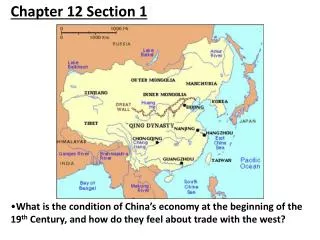
European arrival and Chinese reaction • Europeans brought with them items to trade but the Chinese were not impressed. • China believed it was self sufficient.
Chinese self sufficiency • China believed it was self sufficient because -It had a healthy agricultural economy -Plentiful rice in the south -Maize, corn and potatoes from the Americas -Mining, manufacturing, salt and tin was abundant.
Guangzhou • The only trade port in all of China open to foreigners. • All trade controlled by China • China had a favorable balance of trade.
Opium Wars • Causes- Qing emperor demanded that Britain stop sending Opium to China, Britain refused. • In 1839 war broke out but England won because of its superior weapons and navy. • Treaty of Nanjing- peace treaty ending the war and giving Britain control of Hong Kong and foreigners given extraterritorial rights (not subject to Chinese laws) • Greatly increased Chinese resentment of foreigners.
Chinese international problems • Population grew by 30% but food supplies could not keep up. • Hunger, famine and opium addiction spread. • Soon the Qing faced rebellion.
The Taiping Rebellion • Hong Xiuquan built an organization called the Heavenly kingdom of great peace. • Its goal was to share the wealth and allow no poverty. • In 1853, rebellion broke out and his 1 million man army captured Tapai. • He withdrew from public life and 11 years later the kingdom collapsed due to foreign troops and the imperial army.
Empress Cixi • Proposed that China start a “self strengthening movement” • The goals were to update China’s educational system, diplomatic system and its army in order to resist foreign influence.
Europeans move into China • Nations took advantage of a weakened China as it had failed to strengthen fast enough. • Treaties had also given foreign nations control over parts of China and its economy. • Countries also formed spheres of influence in China- Chinese trade and investment controlled by foreign nations.
Open Door Policy • Letters written by Sec. of State John Hay that stated -China needed to open to free trade. -The U.S. would protect its right to free trade in China -This meant the U.S. had moved into China as an imperial power along with European nations.
Boxer Rebellion • A group known as the Society of righteous and harmonious fists resented foreign influence in China and rebelled against the Dowager Empress. • In 1900, foreign property was destroyed and foreigners were killed or kidnapped. • This rebellion was broken up by a foreign army including the U.S. of 19,000 men.
Impact of the Boxer Rebellion • Empress knew she needed to reform China or face further revolt. • She began to send diplomats throughout the world in order to study western political ways. • She created a national assembly along with a full constitutional government.
Why was China not interested in Britain’s initial trade requests? • Britain had threatened war • China believed it was self sufficient • China already traded with France • China and Japan were economically allied.
Great Britain got control of Hong Kong because • It signed a pledge of international cooperation with China • Japan and Britain divided China • The Treaty of Nanjing • The Boxer Rebellion
The Open Door Policy • Allowed the U.S. to form a military alliance with China • Linked China and Japan economically • Gave the U.S. access to Chinese trade • Was well received by China
The Boxer Rebellion • Was an attempt to install communism in China • Was a reaction to foreign influence in China • Gave the U.S. free trade with China • Improved Chinese exports