Understanding Queues: First In-First Out Data Structure
Queues are a fundamental data structure that follows the First In-First Out (FIFO) principle, analogous to a line at a supermarket. This means the first item added to the queue will be the first one to be removed, preserving the order of elements. Key operations include enqueue (adding items), dequeue (removing items), and peek (viewing the front item). Queues can be implemented using arrays or linked lists, with circular arrays enhancing efficiency. Common applications involve simulations, buffering, and various computational tasks where order matters.

Understanding Queues: First In-First Out Data Structure
E N D
Presentation Transcript
What is a queue? • Stacks reverse the order of items added to them • Last In-First Out • What if we want to preserve the order in which items are added? • Solution: queue • First In-First Out: items removed in the same order they’re added • Similar to line (queue) at bank, supermarket, etc. • Uses in computer science include • Buffering (keyboard, network, etc.) • Simulations • Lots of other stuff Queues
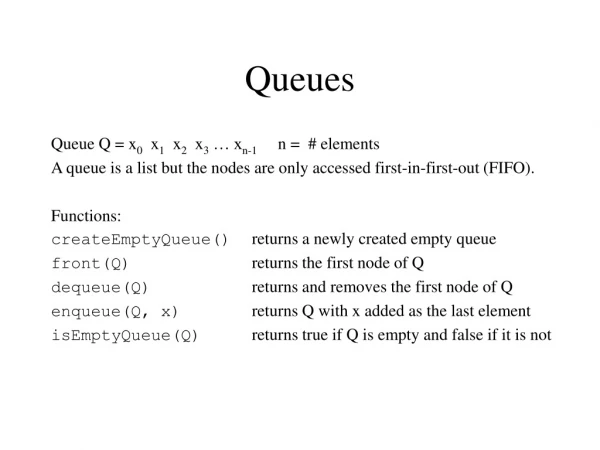
Operations on queues • Same kinds of operations as stacks, but slightly different results • Create • Enqueue: add to the tail of the queue • Dequeue: remove from the head of the queue • Peek: look at the element at the head of the queue • IsEmpty: tell whether the queue is empty • DequeueAll: clear all elements from the queue head A B C D tail Queues
firstNode B C D Queue using circular linked list • Last element in list points back to the first one • Enqueue (adding an element) • newNode.next = lastNode.next • lastNode.next = newNode • lastNode = newNode • Dequeue (removing an element) • firstNode = lastNode.next • lastNode.next = firstNode.next • Peek (look at first element) • firstNode = lastNode.next A lastNode Queues
Details on queues with linked lists • Some methods can throw QueueException (like StackException) • Dequeue() on an empty queue • Peek() on an empty queue • Enqueue() on an empty queue is a bit different • lastNode = newNode • newNode.next = newNode • Dequeue() on a queue with exactly one element is different • firstNode = lastNode • lastNode = null • DequeueAll() can be done by lastNode = null Queues
Queues with arrays? • As with stacks, queues can be implemented with arrays • Naïve implementation • Insert at top of array • Remove from bottom of array (element 0) and shift array contents down one place • Problem: this can be slow for large arrays! • Better implementation: circular array • Keep track of start and end of queue • Queue “wraps around” the end of the array • Use modular arithmetic for array indexes • Space-efficient and fast Queues
Circular arrays for queues • Enqueue • queueArray[back] = item • count++; back = (back+1)%max_queue • Dequeue • item = queueArray[front] • count--; front = (front+1)%max_queue • Wraps around when front or back reaches max_queue • NOTE: this implementation is slightly different from that in Chapter 7 7 0 A 6 1 front B back 2 5 count 1 1 2 0 4 3 Queues
Details on queues with arrays • Some methods can throw QueueException, as with linked list queues • Dequeue() on an empty queue • Peek() on an empty queue • Queue is empty when count==0 • There can be two situations where front==back • If count==max_queue, queue is full • If count==0, queue is emptyˆ • Array-based queue can fill up! • Enqueue() can throw a QueueException if count==max_queue • Make the queue array large enough to avoid this • DequeueAll() can be done by setting front=0, last=0, count=0 • Same code as used to initialize an array-based queue… Queues
Implementing queues (and stacks) • Three choices for implementing queue ADT • List ADT • Array (circular) • Linked list (circular) • List ADT is simpler: less code to write • Array • Fixed maximum size • Low overhead (no link references) • Linked list • Grows to any size • Requires more space for a given number of elements • In languages other than Java, allocating and deleting elements is an issue • This favors arrays, which don’t need to allocate and delete very frequently (array methods don’t call new) Queues
Queue application: simulations • Computers often used to simulate behavior • Customers at a bank • Requests serviced by a roomful of Web servers • Traffic on roadways • All of these simulations consist of events • An event occurs at a given time, determined by the model used in the simulation • Events could include • Car N enters Highway 1 at Morrissey • Car N switches lanes at mile marker X • Car N leaves freeway at 41st Avenue • Simulation must keep track of thousands of events • Events ordered by the time they occur • Must process events in time order • Use a queue! Queues
Sample simulation: supermarket • N checkout lines • Each is FIFO • Each line services the shopper at the front • Time to service is determined by simulation • Shopper may choose a line • Simulation decides how rapidly shoppers arrive • Simulation decides which line a shopper picks • Shortest line • “Express” line? • Test different strategies • Questions to answer: • How many lines should there be? • How should a shopper pick the best line? Queue 1 Queue 2 Queue 3 Queues
Simulating a supermarket • Each line is ordered by time • Customer at front of line is next to finish (in that line) • Amount of time to finish determined by simulation • Simulation picks next to finish from front of all queues • Advances “time” to t • Dequeues the customer who finishes at time t • This repeats as long as simulation runs • More advanced simulations may have more complex queueing • Time spent in each aisle • Time spent looking for items • Even more detail… Queue 1 Queue 2 Queue 3 Queues
For next time… • Hash tables: Chapter 12 in C&P • Work on assignments • Due Friday, Feburary 1st at 10:00:00 PM PST • Don’t forget: design documents must be named design.pdf or design.txt! • Class with main must be named WordCount • Resources available • Help from TA’s, tutors, and professor • MyFile.java class (available online) for reading files Queues