Build Your Own Scratch Robot Motor Controller with MOSFET and Light Sensors
Explore the exciting world of robotics with our DIY Scratch Robot Motor Controller project. This guide provides step-by-step instructions for creating a MOSFET motor controller using essential tools and components. Learn how to integrate light sensors to control motor operation based on light conditions. With a detailed circuit diagram and truth table, this project is perfect for hobbyists and students alike. Gather your components, unleash your creativity, and build your own intelligent robotic system!

Build Your Own Scratch Robot Motor Controller with MOSFET and Light Sensors
E N D
Presentation Transcript
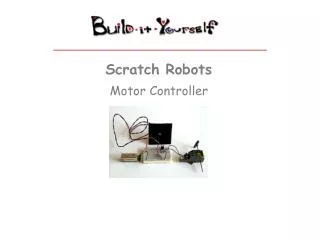
Scratch Robots Motor Controller
Scratch Robots Motor Controller Tools Radio Shack Tools $ 9.00 – Test Jumpers $ 3.00 – Screw driver $ 7.00 – Wire Strippers $ 20.00 – Multimeter -------------------------- $39.00 - Total Tools www.build-it-yourself.com
Scratch Robots 3-state Motor Controller Motor Controller Radio Shack Parts $ 9.00 – 1-1/8” Modular IC Breadboard $ 3.00 - Photo Resistors $ 3.00 - 22 Gauge Hookup Wire $ 3.00 - 10K Potentiometer x2 $ 3.00 - 9V connector $ 4.00 – 1A, 30V diode x 4 $ 2.50 - 9V battery -------------------------- $27.00 – Sub Total Pololu Part pololu.com/catalog/product/24 $ 3.00 SN754410 Quadruple Half-H Driver Geared Motor hobbyengineering.com/H2028.html $10.00 Several Tamiya options $40.00 Total Parts pictures Circuit Board www.build-it-yourself.com
D1 1A 30V Scratch Robots 3-state Motor Controller +9V R1 Photo resistor 2K light 50K dark 8,16 R5 10K D2 2 1 R2 10K 3 R3 5V to 9V DC Motor 1A 7 6 R4 D3 D4 4,5,12,13 www.build-it-yourself.com
Scratch Robots 3-state Motor Controller • Truth Table: • Light Sensor R1 Black White Black White • Light Sensor R2 Black Black White White • Motor State Off Right Left Off • Wish List: • Make a printed circuit and solder parts • Add clockwise, counter clockwise lamp • Add on/off lamp • Add on/off switch • Research geared motors and shaft accessories www.build-it-yourself.com
Scratch Robots On/Off MOSFET Motor Controller When the light sensor sees black, the motor is OFF. When the light sensor sees white, the motor is ON Motor Controller Radio Shack Parts $ 9.00 – 1-1/8” Modular IC Breadboard $ 2.00 - IRF510 N-channel MOSFET $ 3.00 - Photo Resistors $ 3.00 - 22 Gauge Hookup Wire $ 1.50 - 10K Potentiometer $ 3.00 - 9V connector $ 2.50 - 9V battery -------------------------- $24.00 - Total Circuit Board www.build-it-yourself.com
Scratch Robots On/Off MOSFET Motor Controller +6V to 9V R1 Photo resistor 2K Ohms light (on) 50K Ohms dark (off) 5V to 9V DC Motor 1A VGate G D R2 10K S www.build-it-yourself.com
Scratch Robots On/Off MOSFET Motor Controller +6V to 9V R1 Photo resistor 2K Ohms light (on) 50K Ohms dark (off) 5V to 9V DC Motor 1A VGate Q1 IRF510 N-channel MOSFET 2V-4V GS trigger voltage 20V GS Max voltage 4A DS current G – Gate D – Drain S – Source G D R2 10K S If the voltage between the Gate and Source, VGate, of this N-channel MOSFET is < 2 volts, no current can flow between the Drain and Source terminals. The motor will not run. If the Gate to Source voltage is > 4 volts, then current will flow between the Drain and Source and the motor will run. Adjust R2 so motor is off when R1 sees no light. The Gate voltage should be < 2 volts. When R1 sees light, its resistance should decrease raising the Gate voltage > 4 volts. Then the motor will run. Radio Shack Breadboard MOSFET On/Off Controller Build-It-Yourself www.build-it-yourself.com
Scratch Robots MOSFET Motor Controller Voltage Divider (FET Gate Bias Control) 9V VGate 9V R2 R1+R2 = VGate 9V 10K 4K(light)+10K VGate = 6.4V R1 Photo Resistor = VGate R2 Variable Resistor VGate 9V 10K 16K(dark)+10K VGate= 3.4V = www.build-it-yourself.com
Standard Radio Shack Light Sensor package of 6. Min ohms - White Med ohms - Grey Max ohms - Black The Problem: In a package of 6 light sensors, the resistance varies significantly. Note: Test No. 1, 3, 6 have the same physical size. Their resistance ranges are closer to each other than to other three. For 1, 3 and 6, the thresholds may be set, i.e. to 10 K Ohm and 25 k Ohm. Updated 10/05/2010