Download
1 / 13
130 likes | 226 Vues
This paper presents a method for the incremental construction of Voronoi diagrams and Delaunay triangulations, key structures defined for a set of n points or line segments. Traditional construction methods require Θ(n log n) time in the worst case. The method outlined in this study simplifies the process and enhances efficiency, making it possible for implementation in practical applications. The results are demonstrated through an implementation available online. The research receives support from NSERC and the ESPRIT IV LTR Project No. 21957 (CGAL).

E N D
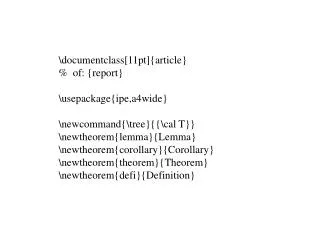
\documentclass[11pt]{article} % of: {report} \usepackage{ipe,a4wide} \newcommand{\tree}{{\cal T}} \newtheorem{lemma}{Lemma} \newtheorem{corollary}{Corollary} \newtheorem{theorem}{Theorem} \newtheorem{defi}{Definition}
\begin{document} \title{Good orders for incremental (re)construction\thanks{This research is supported by the NSERC and by the ESPRIT IV LTRProject No.21957 (CGAL). }} \author{Jack Snoeyink\\ Dept. of Computer Science\\ University of British Columbia \and Marc van Kreveld\\ Dept. of Computer Science\\ Utrecht University\\ } \date{} \maketitle
\begin{abstract} Voronoi diagrams, Delaunay triangulations, and vertical decompositionsin the plane are structures that are canonically defined for a set of$n$ points or line segments. Construction requires $\Theta(n\log n)$ timein the worst case. The method is simple and our implementation can beseen at {\footnotesize {\tt http://www.cs.ubc.ca/spider/snoeyink/terrain/Demo.html}} \end{abstract}
\chapter{Dynamic programming} % Nodig: \documentclass{report} \section{Introduction} \subsection{Background} \subsubsection{The early years} \paragraph{Example.}
{\bf dikgedrukt} {\it scheefgedrukt}, {\em benadrukt} \footnotesize \small \large \Large \LARGE {\sf sans serif font} {\tt typewriter font} \smallskip \medskip \bigskip \\ % Commentaar Line breaks onbelangrijk; lege regel(s) geeft nieuwe alinea
\begin{itemize} \item Het is mooi. \item Het werkt snel. \item Het is robuust. \end{itemize} enumerate: \item description: \item[Vooraf:]
$n$, $T$, $t \in S$ $k \choose 2$ $\frac{n-4}{n+i-1}$ $O(n \log n)$ $n^2$, $k^{11}$, $P_i$, $M_{i,j}$ $\sum_{i=1}^{n} i^2 $ $\triangle$, $\alpha$, $\rightarrow$, $\Rightarrow$ \[ \sum_{i=1}^{n-3} … \]
\begin{defi} Een {\em graaf} is een verzameling $V$ met knopen en een verzameling $E$ van edges, met voor een edge $e=(u,v)$ waarbij $u,v \in V$. \end{defi}
\begin{figure}[htb] \begin{center} \Ipe{mis.ipe} \end{center} \caption{An independent set with 31 vertices out of a triangulation with 100 vertices.} \label{fig:independentset} \end{figure} … in Figure~\ref{fig:independentset} …
\begin{table}[htb] \begin{center} \begin{tabular}{|l|r|r|} \hline & size with method A & size with method B \\ \hline Test 1 & 1,345 & 1,245 \\ Test 2 & 923 & 999 \\ \hline \end{tabular} \end{center} \caption{Results for …} \label{tab:comparison} \end{table} … in Table~\ref{tab:comparison} …
\bibliographystyle{plain} \bibliography{socg} \end{document} socg.bib is een file met entries in bibtex format N.B. Bibtex format entries zijn overal op het Web te vinden, bijv. Digital Bibliography & Library Project: http://dblp.uni-trier.de/
@Article{af-panp-84, author = {John Ahn and Herbert Freeman}, title = {A program for automatic name placement}, journal = {Cartographica}, volume = 21, number = {2--3}, year = 1984, pages = {101--109}, update = {97.07 agarwal} } … in~\cite{af-panp-83}, …
@inproceedings{af-panp-83, author = {John Ahn and Herbert Freeman}, title = {A Program for Automatic Name Placement}, booktitle = {Proc. Auto-Carto 6}, year = 1983, pages = {444--453} } @book{mf-gdspa-89 , author = "H. Matthews and I. Foster" , title = "Geographical Data -- Sources, Presentation, and Analysis" , publisher = "Oxford University Press" , year = 1989 , address = "London" , update = "95.12 kreveld" }