Finding Smallest Integer Satisfying Modular Conditions
This study explores the problem of finding the smallest integer ( x ) that satisfies a set of modular conditions based on three different line-up scenarios. The first condition requires ( x equiv 1 ) (mod 3), the second condition requires ( x equiv 2 ) (mod 4), and the third condition requires ( x equiv 3 ) (mod 5). Through systematic analysis using modular arithmetic and algebra, we find that the smallest solution is ( x equiv 58 ) (mod 60), revealing the relationships among the conditions and how to derive multiple valid solutions from them.

Finding Smallest Integer Satisfying Modular Conditions
E N D
Presentation Transcript
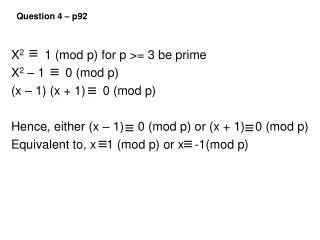
Question 4 – p92 X2 1 (mod p) for p >= 3 be prime X2 – 1 0 (mod p) (x – 1) (x + 1) 0 (mod p) Hence, either (x – 1) 0 (mod p) or (x + 1) 0 (mod p) Equivalent to, x 1 (mod p) or x -1(mod p)
Question 6 – p92 Let x = the total number of people, Line up 3 rows, 1 left over : x 1 (mod 3) Line up 4 rows, 2 left over : x 2 (mod 4) Line up 5 rows, 3 left over : x 3 (mod 5) Find the smallest x that satisfy 3 conditions.
Question 6 – p92 x 1 (mod 3) Let x = 3n + 1 (for some n is positive integer) x 2 (mod 4) 3n + 1 2 (mod 4) 3n 1 (mod 4) n 3 (mod 4) n = 4m + 3 (for some m is positive integer)
Question 6 – p92 Now, x = 12m + 10 x 3 (mod 5) 12m + 10 3 (mod 5) 12m -7 -2 3 (mod 5) 4m 1 (mod 5) m 4 (mod 5) m = 5o + 4 (for some o is positive integer) Hence x = 60o + 58 Possible x : 58, 118, 178, 238, 298, 358 ….. Notice : 12 = lcm(3,4) 60 = lcm(3,4,5)