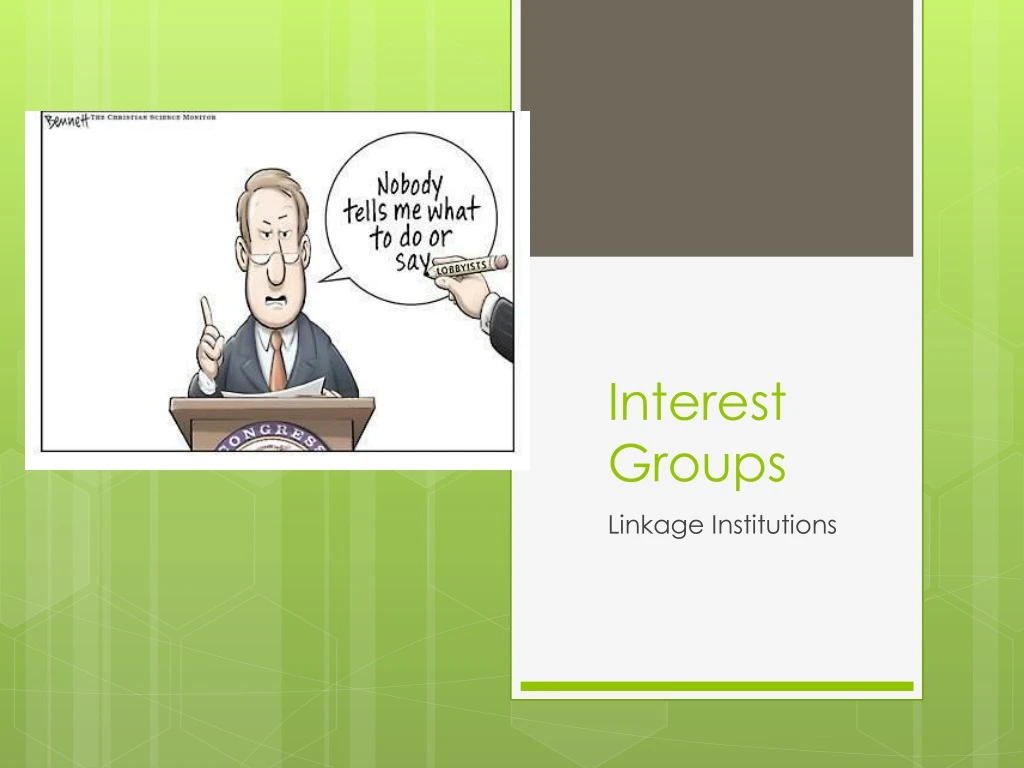

Interest Groups
E N D
Presentation Transcript
Interest Groups Linkage Institutions
Interest Groups • Organized group of individuals seeking to influence the government and policies *they operate at all levels of government (state and national)
Lobbyist • Representative for an interest group
MNC • Preserve Mac and Cheese!! • We are dedicated to protecting this national treasure! Mill KeeChedda (lobbyist)
So why would a group like “MNC” need a lobbyist? • Turn to an elbow partner and come up with 2 reasons
Now, in all seriousness … why would a group like PETA or a labor union or the NRA form? Why would they need lobbyists? • With your elbow partner, come up with two reasons.
Representation • Serves as a link between government and the people
Education • Increase people’s awareness and interest • Educate government with data to make good policies
Participation • People work together for a common goal
Agenda building • Bring issues to public and government attention • Make sure something is done to fix issues
Program Monitoring • Keep track of government programs that are important to the group’s goals
In your own words … • What is the function of interest groups in our government? • In other words, what do they do?
Why do interest groups form? • Remember Federalist No. 10?? – Madison says factions are undesirable but inevitable • Why? People naturally group together to address concerns, interests, etc.
How do interest groups link the government to the people? • Express members’ desires to elected officials • Convey government policy plans to the people • Raise and spend money to influence government officials
How are interest groups different from political parties? • Parties: ELECT individuals to office, focus on broad topics and are accountable to all people • Interest Groups: INFLUENCE elected officials, focus on one topic, and are accountable only to members (private organization)
How do Interest Groups connect people to the government? • What do you think? • Give examples!
Types of Interest Groups • Economic Interest: primary purpose is to promote the financial interests of its members • Business • Labor • Professional • Agricultural
Business • Companies have interest groups monitor legislation that may impact business • Examples: Chamber of Commerce, NAM (National Association of Manufacturers)
Labor • Union organizations that represent worker’s rights • Examples: AFL-CIO (American Federation of Labor – Congress of Industry Organization)
Professional • Membership based on job • Examples: NEA (educators), AMA (medical), ABA (American Bar Association – lawyers)
Agricultural • Shape agricultural/farming policies EX: National Farmers Union, Farm Bureau
Types of Interest Groups: • Public Interest – wants collective good that doesn’t focus on benefitting just one group of people • Environmental • Equality • Single-issue
Environmental • wilderness protection, pollution, animal rights, no offshore drilling, etc. • Ex: PETA, WWF (World Wildlife Federation) and Sierra Club
Equality • Equal rights for minority groups • Ex: NOW, NAACP, VFW and AARP
Single-Issue • Focus on one issue (instead of a group of people) • Ex: Planned Parenthood, NRA
If you were going to join an Interest Group, which would you join? Why?
Strategies • What do interest groups do?
Influencing elections/electioneering • Campaign contributions (amount is limited per candidate PACs) • Grassroots efforts • Public awareness
Litigation • Take issues to court if Congress won’t support (example: NAACP supports Brown v. Board case because Congress wasn’t moving forward on segregation legislation) • Class-action suit: people combine lawsuits into 1 stronger case • Amicus curiae brief – legal document by “friend of the court” supporting 1 side of a case
Going public: • Appeal to the people for support • Raise awareness of issues • Raise money through PACs • PACs are formed by interest groups to raise money for campaign or candidate
Lobbying ** • Try to influence the government (policymakers) by providing information and data
Direct Lobbying: use of personal contact • Congress – many lobbyists were Congressmen and have friends in Congress • Executive – provide decision makers at all levels with information to help implement laws • Judicial – litigation, amicus curiae briefs (cannot directly “lobby” judges, would be improper)
Grassroots Lobbying • “the people back home” • Write letters, emails, fax, phone calls, petitions to representatives/senators
Coalition Lobbying • Several groups join together for a common goal
Protest/radical lobbying • Use force to bring attention to a cause • Examples: PETA (red paint or “blood” of fur worn by celebrities), Civil Rights groups (sit-ins, protest marches, etc.)
What is lobbying? • With your elbow partner, come up with 3 characteristics of lobbying. Be prepared to share!
What makes interest groups successful? • Size • Leaders • Intensity • Money
Size • More people = more calls, emails, campaign work and bigger protests • BUT more people can lead to conflict AND free-rider problem • Free-rider – people who benefit from work of the group without doing any work
Leaders • Strong, charismatic leaders find a way to attract members and are persuasive about importance of issues
Intensity • The more passionate the members are about a cause the more effort they will put into the group
Money • Groups need funding to hire lobbyists, support PACs, write amicus curiae briefs and other activities • More money can make up for less passion from members
Think of an example of a successful interest group… 1. Why are they successful? 2. What is their goal and how do they achieve it?