Download
1 / 56
560 likes | 669 Vues
This comprehensive overview explores the relationships between molecular shape, dispersion forces, molar mass, and polarity. It explains how these factors influence intermolecular forces (IMFs) and contributes to the understanding of boiling and evaporation processes. Examples such as carbon disulfide (CS2), methanol (CH3OH), ethanol (CH3CH2OH), water (H2O), and aniline (C6H5NH2) are used to illustrate concepts. Additionally, the differences between boiling and evaporation are delineated, alongside analyses of cooling and heating curves for substances like stearic acid and water.

E N D
Molecular Shape and Dispersion Forces What is the relationship? Why does it exist?
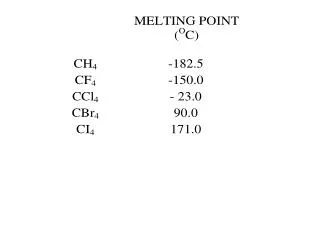
Molar mass and Dispersion Forces What is the relationship? Why does it exist?
Polarity and Strength of IMFs What is the relationship? Why does it exist?
Carbon disulfide: CS2 • Methanol: CH3OH • Ethanol: CH3CH2OH • Water: H2O • Aniline: C6H5NH2
What is the difference between boiling and evaporation?