Constitutional Challenges in the Forfeiture of Immovable Property Rights in South Africa
This thesis explores the constitutionality of forfeiture of immovable property under South African law, focusing on the implications of laws such as the City of Cape Town Draft Problem Building Bylaw (2009) and the Prevention of Organised Crime Act (POCA). It investigates three core constitutional issues: the arbitrariness of forfeiture, whether it constitutes expropriation, and the procedural fairness concerning eviction. The analysis highlights how these principles intersect with the rights enshrined in the South African Constitution, prompting reflections on fairness in property rights.

Constitutional Challenges in the Forfeiture of Immovable Property Rights in South Africa
E N D
Presentation Transcript
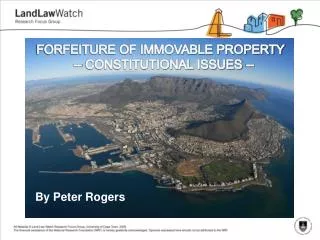
FORFEITURE OF IMMOVABLE PROPERTY -- CONSTITUTIONAL ISSUES -- By Peter Rogers
The Issue: • The constitutionality of forfeiture of immovable property. Particularly, to what extent does the Constitution allow for rights in immovable property to be abrogated by statute?
STRUCTURE OF MY THESIS • I: INTRODUCTION • II: CASE STUDY: CITY OF CAPE TOWN DRAFT PROBLEM BUILDING BYLAW 2009 • III: PREVENTION OF ORGANISED CRIME ACT [POCA] • IV: CONSTITUTIONALITY • V: APPLICATION TO THE BYLAW
THE BYLAW • “problem building” includes any building or land that shows elements of the • following: • (a) appears to have been abandoned by the owner… • (b) is derelict in appearance, overcrowded or is showing signs of becoming • unhealthy, unsanitary, unsightly or objectionable; • (c) is the subject of numerous complaints from the public… • (d) is illegally occupied; • (e) refuse or waste material is accumulated, dumped, stored or deposited • on such building; or • (f) any building partially completed, abandoned or structurally unsound and • posing any risk contemplated in paragraphs (a) to (e).
S 5 (2) The City may…clean, repair, renovate, repaint, alter, close, demolish or • secure any problem building at the cost of the owner. • S 5(5) (a) order the owner of any problem building to remove…any person occupying or working [sic], or who for any other purpose is in such problem building… • (b) order any person occupying or working, or who for any other purpose is • in any problem building, to vacate such building. • S 8(2) A person who is guilty of an offence in terms of this By-law is upon • conviction liable to a fine of R20 000.00 or imprisonment for a period not exceeding two years or to both.
The Three Constitutional Issues • Is the forfeiture arbitrary? • Does the forfeiture amount to an expropriation? • Procedural – does the bylaw amount to an eviction?
!!?? !!?? PROBLEMS • Uncertainty • Inconsistency – an unlawful deprivation might nonetheless be a lawful expropriation.
!!?? !!?? De Waal Argument: • You can never use s 36 iro s 25 • Suppose unlawful ito s25 (1) because not a law of general application. • Says s 36 “the rights in the BoR may only be limited ito a law of general application…” • Thus to justify must show that a law not of general application is of general application.
Michelman • Rejects De Waal argument • A law that is arbitrary can be reasonable and justifiable
The starting point is always ‘deprivations’ • Therefore every case begins with arbitrariness 12 12
FNB: Sufficient Reason • Deprivation is arbitrary when the law does not provide sufficient reason for the deprivation or is procedurally unfair • Sufficient reason is a flexible concept that spans from mere rationality to full proportionality
The Next Step • The POCA cases suggest that forfeiture of immovable property requires proportionality [iehighly reviewable] • Therefore the bylaw could be arbitrary • But can it be saved by s 36?
Bibliography • Cases • First National Bank of SA Ltd t/a Wesbank v Commissioner, South African Revenue Service 2002 (4) SA 768 (CC) • Mohunram and Another v National Director Public Prosecutions and Another (Law Review Project as Amicus Curiae) 2007 4 SA 222 (CC) • Prophet v National Director Public Prosecutions [2006] JOL 18376 (CC) • Statutes • Constitution of the Republic of South Africa, 1996 • City of Cape Town Problem Building Bylaw (draft) 2009 • Other • Ian Currie & Johan de Waal The Bill of Rights Handbook 5ed 2005 • Frank Michelman “Against regulatory taking: in defence of the two-stage inquiry: a reply to Theunis Roux” in Michael Bishop & Stu Woolman (eds) Constitutional Conversations 2008