
Understanding Gibbs Free Energy, Phase Changes, and Chemical Equilibrium in Thermodynamics
E N D
Presentation Transcript
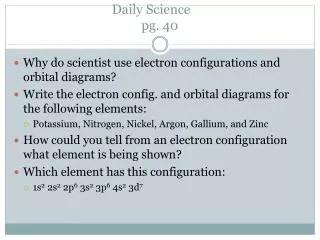
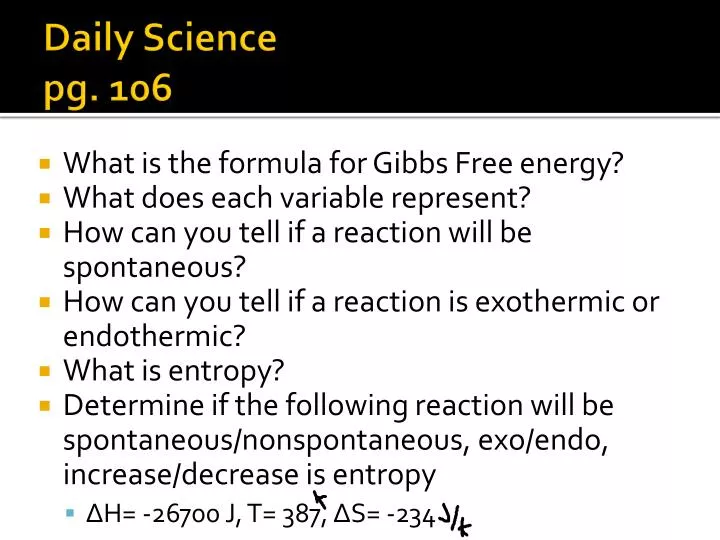
Daily Sciencepg. 106 • What is the formula for Gibbs Free energy? • What does each variable represent? • How can you tell if a reaction will be spontaneous? • How can you tell if a reaction is exothermic or endothermic? • What is entropy? • Determine if the following reaction will be spontaneous/nonspontaneous, exo/endo, increase/decrease is entropy • ΔH= -26700 J, T= 387, ΔS= -234
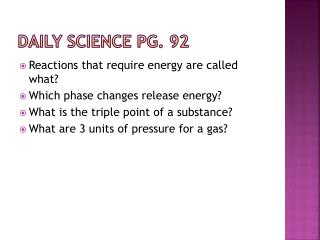
Daily Science pg. 106 • Name one property of a solid, liquid, and gas. • Separate the phase changes into endothermic and exothermic processes. • How do you find the boiling point of a substance on a phase change diagram? • Draw a sketch of a phase change diagram and label the solid, liquid, and gas phases. • How do you know a state change is taking place on a freezing and boiling point graph? • How many moles of a gas are present at a pressure of 798 torr, a volume of 278 mL, and a temperature of 45 oC? • How many liters of NH3 can be made from 5.6 g of H2? • N2+ 3H2 2NH3 • What is the specific heat of a 4.3 g piece of metal that absorbs 1987 J of heat energy and the temperature changed from 16 oC to 54 oC • Using the Gibbs free energy equation, describe the following process: • ΔH= -25 KJ, T= 124 K, and ΔS= 5.o KJ/K
Pg. 105 Chemical Equilibrium
Equilibrium • Most reactions do not go to completion. They are reversible • Use a double arrow to show that an equation can be reversed • Chemical equilibrium happens when the forward and backward reactions balance each other because they take place at equal rates • As the concentration of reactants decrease, concentration of products increase
Example • The formation of NH3. Used in fertilizers • N2 + 3H2 2NH3
Determining equilibrium (homogeneous) • Can determine equilibrium constant- Keq • Concentrations of the products raised to the power of their coefficients/ concentrations of the reactants raised to the power of their coefficients • aA + bBcC + dDKeq= ([C]c[D]d)/ ([A]a[B]b) • K > 1: more products that reactants @ equil • K < 1: more reactants than products @equil
Example • Write the expression for finding the equilibrium constant for the following reaction: • N2 + 3H2 2NH3 • Find the equilibrium constant if the concentration of N2 is 0.533 mol/L, H2 is 1.600 mol/L, and NH3 is 0.933 mol/L
Le Chatelier’s principle • Says if a stress is applied to a system at equilibrium, the system shifts in the direction that relieves the stress • Can predict how changes in temp, concentration, and volume (pressure) will effect equilibrium • V and P related- if you increase the volume, you decrease the pressure • Longer arrow shows which way equilibrium will shift ( or )
Changes in concentration • An increase in the concentration of a reactant shifts the reaction toward the product • Ex. CO +3H2 CH4 + H2O • If products are removed, it will shift toward the products
Changes in volume • If you decrease the volume (increase pressure) reaction will shift to the side with the smaller amount of moles. • Ex. CO +3H2 CH4 + H2O
Changes in temperature • Alters both equilibrium position and constant • The reaction will shift in the opposite direction when the temperature is added • Exothermic shift to left • Endothermic shift to right