Solutions
This comprehensive overview introduces the fundamental concepts of solutions, including the definitions of solute, solvent, and solubility. It examines types of solutions—unsaturated, saturated, and supersaturated—while explaining the properties of electrolytes. Learn about factors affecting solubility such as agitation, particle size, and temperature, and gain insight into calculating molarity and performing dilutions. The content emphasizes the "like dissolves like" principle and the unique properties of water that contribute to its effectiveness as a universal solvent.


Solutions
E N D
Presentation Transcript
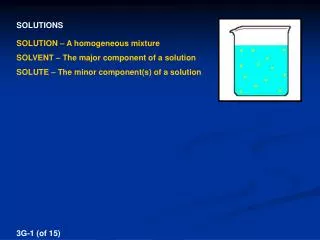
Solution – homogeneous mixture in which solute & solvent particles are evenly distributed in one another • solvent – the dissolving medium; thing that does the dissolving • solute –the dissolved particles; thing that is dissolved • solutes and solvents can be solids, liquids, or gases
Solubility – amount of solute that dissolves in a quantity of solvent at certain temperature and pressure Solutions can be: a) unsaturated – contains less solute than solvent can possibly dissolve b) saturated – contains as much solute as can be dissolved by solvent
c) supersaturated – contains more solute than can normally be dissolved by solvent; not very stable – slight disturbance to solution will cause solute to precipitate or crystallize
Terms related to solubility • soluble– substance that will dissolve in a solvent • insoluble – substance that will not dissolve in a solvent • miscible – when 2 liquids will dissolve in each other in any proportion (ex: water and ethanol) • immiscible – when 2 liquids are insoluble(ex: water and oil)
Electrolytes • excellent conductors in liquid state or dissolved in water (aqueous) • In order for a solution to carry an electrical current, it must contain ions that are free to move. • Acids, bases and ionic compounds all ionize (break into ions) in water to form free ions. http://www.schooltube.com/video/36d820507a4c220061eb/The-Basics-on-Electrolytes
Factors Affecting Solubility • agitation of the system – increases collisions between solute and solvent particles • particle size – smaller dissolves faster because more surface area • temperature – solutes generally dissolve faster at higher temps. – higher kinetic energy at higher temps. – stronger and more frequent collisions between solute and solvent particles - Exception: solubility of gases inversely proportional to temperature
Concentration of Solutions • Molarity – M – mols of solute per L of solution • Example: 5 M – dissolve 5 mol of solute in enough solvent to make 1 L of solution
Calculating molarity (M) • convert mass of solute (g) to mol using molar mass • convert volume of solution to L • use formula: M =molssolute literssolution
Example 1 • What is the molarity of 2.3 moles of sodium chloride in 0.45 liters of solution? M=molssolute literssolution M = 2.3 mol = 5.1 M 0.45 L
Example 2 What is molarity of a solution prepared by dissolving 37.94 g of KOH in H2O, then diluting the volume to 500 mL? mass = 37.94 g KOH 1 mol KOH = 0.676mol 56.11 g KOH molar mass KOH volume = 500 mL 1 L = 0.500 L 1000 mL molarity = 0.676 mol = 1.35 M 0.500 L
Dilutions • stock solution – mixture w/ high concentration of solute; can be diluted by adding additional solvent to get molarity needed • use this equation to solve for unknown: M1· V1 = M2· V2
Example What is the molarity of a solution that is made by diluting 50.0 mL of 4.74 M solution of HCl to 250.0 mL? • M1 = 4.74 M • V1 = 50.0 mL • M2 = ? • V2 = 250.0 mL M1V1 = M2V2 • M2 = 0.948 M
“Like dissolves like” Rule • Polar solvents dissolve ionic and polar solutes • partial positive & negative charges of polar molecules are attractive to one another • Due to an uneven sharing of electrons in a molecule • polar solvents with partial + and – charges are attracted to + and – ions in ionic compounds • Nonpolar solvents dissolve nonpolar solutes http://www.mhhe.com/physsci/chemistry/essentialchemistry/flash/molvie1.swf
The Uniqueness of Water! • Structure of H2O • Lewis Dot Structure • VSEPR Shape • Electronegativity (H=2.1 and O=3.5) • Hydrogen bonding
Physical Properties of Water • Density of Ice • Universal Solvent • High melting and boiling points • Cohesion (surface tension) • Adhesion (capillary action) • High specific heat (ability to hold heat) ALL OF THESE ARE DUE TO THE STUCTURE OF WATER (polar and hydrogen bonds)!!!