Overhead Calculation for Lorentz Detuning Force in Superconducting Cavities
This paper by Rihua Zeng discusses the overhead calculations associated with Lorentz detuning force in superconducting cavities. The study emphasizes pre-detuning as a means to reduce overhead, exploring cavity performance under optimal and non-optimal quality factors (Ql). Key findings indicate that when detuning remains within half the cavity bandwidth, the overhead can be minimized. The analysis reveals the interplay between detuning rates and the overhead associated with Lorentz force detuning, particularly in spoke cavities and under mechanical resonance. Recommendations for optimal pre-detuning are included.

Overhead Calculation for Lorentz Detuning Force in Superconducting Cavities
E N D
Presentation Transcript
Power Overhead Calculation For Lorentz Detuning Force Rihua Zeng 2012-Mar-20
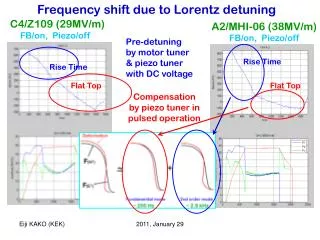
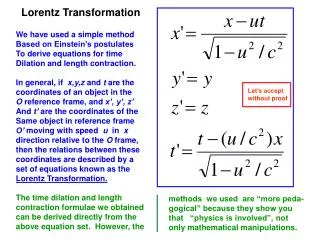
Overhead calculation for cavity with non-optimal Ql • It makes calculation easier to discuss detuning according to the rate Δf/f1/2 • Below f1/2 , ( K~1.5 for high beta, K~2 for med beta), most cavity overhead is <7%. • 25% or more are required for detuning > 2 f1/2 (K~3 for high beta, K~4 for med beta) • Appropriate pre-detuning for both sync. phase and LFD is assumed
Overhead for Lorentz force detuning in Spoke cavity Some measured data about LFD of spokes is 4~8 Hz/(MV/m)2. Worse data in some individual measurement. Overhead is relatively higher in the beginning section of spokes
Conclusion • The overhead could be reduced to a small value if the detuning is limited into half cavity bandwidth with lower LFD coefficient, optimal pre-detuning for LFD, and avoiding mechanical resonance. • Overhead increases by the square of rate Δf/f1/2 . 25% or more are required for detuning Δf/f1/2 > 2 (K~3 for high beta, K~4 for med beta) , under optimal pre-detuning for LFD • It seems non-significant overhead is required for Ql variations ±5% • More overhead is required for some spoke cavities at the beginning of spoke section. • Need to investigate more details for mechanical modes of cavities at ESS.