Transformations and Evaluations of Exponential Functions in Mathematics
160 likes | 296 Vues
Explore the nuances of exponential functions, including their transformations, evaluations, and the significance of the natural base "e." Discover how to shift graphs through vertical and horizontal movements, and understand the concept of compound interest, including its application in real-world scenarios. We’ll tackle the practical application of these functions through exercises such as comparing returns on different investment strategies. Enhance your mathematical skills with an assignment based on real examples from compounding interest.


Transformations and Evaluations of Exponential Functions in Mathematics
E N D
Presentation Transcript
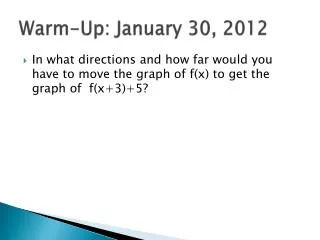
Warm-Up: January 30, 2012 • In what directions and how far would you have to move the graph of f(x) to get the graph of f(x+3)+5?
Exponential Functions Section 3.1
Exponential Functions • The variable is an exponent. • Can be written in the form • b is called the base. b>0, b≠1
Examples Exponential Functions NOT Exponential
Evaluating Exponential Functions • Use the “^” on the TI-83 for exponents • Put ()’s around fractions or other expressions that are either the base or exponent • DO NOT put ()’s around a·b
You-Try #1 (like HW #1-10) • Approximate using a calculator. Round to three decimal places.
Graph of y=bx • Domain is all real numbers, (-∞, ∞) • Range is all positive numbers, (0, ∞) • The y-intercept is 1 • The graph is monotonically increasing for b>1 • The graph is monotonically decreasing for 0<b<1 • The x-axis is a horizontal asymptote • The graph is one-to-one
Transformations of • Similar to transformations we’ve seen before • “d” shifts the graph right/left • “c” shifts the graph up/down • “a” stretches/shrinks the graph • Negatives in a or x cause reflections
The Natural Base, “e” • The irrational number “e” is called the natural base. • “e” is a real number similar to π
Compound Interest • Suppose you want to invest money. The amount that you invest is called the principal, designated by “P”. • Compound interest is when you receive interest on previous interest in addition to on your principal. • The investment’s interest depends on the annual percentage rate, r, which is expressed as a decimal (i.e., 5% 0.05)
Interest Compounded Yearly • Assume “P” dollars are invested with an annual percentage rate of “r”
Compound Interest Formulas • If interest is compounded “n” times a year for “t” years • If interest is compounded continuously for “t” years
Example 6 (like HW #41-44) • Suppose that you have $5000 to invest. Which investment yields the greatest return over 5 years: 5.25% compounded quarterly or 5.1% compounded continuously?
You-Try #6 (like HW #41-44) • Suppose that you have $2000 to invest. Which investment yields the greatest return over 2 years: 4.5% compounded monthly or 4.3% compounded continuously?
Assignment • Page 364 #1-10, 19-24, 41-44, 55