Download
1 / 14
170 likes | 307 Vues
Join us for a comprehensive Child Protection in Emergencies (CPIE) Coordination Training session designed to enhance your understanding of the humanitarian reform and cluster approach. This training will equip participants with the necessary skills in coordination, facilitation, and conflict resolution through engaging methodologies such as participatory approaches, group exercises, and discussions. At the end of the training, you will be better prepared to lead effective sub-cluster coordination and foster strong collaborative partnerships within the humanitarian framework.

E N D
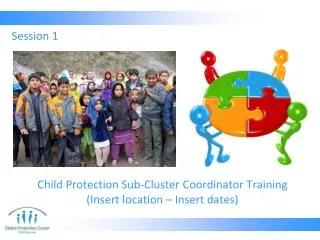
Child Protection Sub-Cluster Coordinator Training(Insert location – Insert dates) Session 1
As you wrap your piece of string around your finger Introduce yourself – name and organisation Any expectations for the training Stop once your string is finish and wrapped around your finger Introduction and Expectations –
Pre-Course Surveys • On a scale from 1 to 10 where do you sit? • Where do you think your country sits in regards to CPIE coordination, where 1 is least successful and 10 is most successful? • Where do you stand in regards to confidence in coordination of CPIE, where 1 is not confident and 10 is very confident? 1 10
Pre-Course Surveys • On a scale from 1 to 10 where do you sit? • Who feels they know and understand the Functions of Coordination, where 1 is not confident and 10 is most confident and you can explain them? • How confident do you feel to take on a CP coordination role today? 1 10
- Focus is on CPIE Coordination Training Objectives • Develop a clear understanding of humanitarian reform and the cluster approach; • Understand the functions, roles and responsibilities of sub-cluster coordination; • Develop strategies to encourage and develop strong collaboration and partnerships; • Know how to access and use key tools and resources important to sub-cluster coordination; • Have increased capacity to lead and support more effective sub-cluster coordination. - Not CPIE Programming
At the end of this training you will: • Be fully familiar with: • Humanitarian Reform and Cluster Approach • Roles, responsibilities and accountabilities • Management and monitoring processes • Mandate and relevant work processes • Tools, standards and sources of information • Inter-cluster and inter-agency linkages
At the end of this training you will: • Have strengthened skills in: • coordination, facilitation, conflict resolution, decision-making, planning, capacity mapping, communication, advocacy and resource mobilisation • Be better able to apply management skills: • for more effective cluster performance and achievement of results
Monday Our 5 day agenda… Tuesday Wednesday Thursday Friday 2
Methodologies • Adult learning principles • Participatory approaches • Individual and Group Exercises • Lectures • PowerPoint • Discussions in Plenary • Planning • Outside presenters • Readings

![Resilience Systems Analysis [insert place and dates]](https://cdn4.slideserve.com/254872/resilience-systems-analysis-insert-place-and-dates-dt.jpg)

![[Insert County] Poll Worker Training](https://cdn0.slideserve.com/795778/slide1-dt.jpg)
![[Insert County] Poll Worker Training](https://cdn0.slideserve.com/1012033/slide1-dt.jpg)
![Presentation to [insert name]](https://cdn1.slideserve.com/1590687/presentation-to-insert-name-dt.jpg)

![[Insert your presentation title here.]](https://cdn1.slideserve.com/1999241/slide1-dt.jpg)




![[Insert your presentation title here]](https://cdn2.slideserve.com/3953758/insert-your-presentation-title-here-dt.jpg)