Understanding Horse Face and Leg Markings: Identification and Description
430 likes | 548 Vues
This resource aims to enhance students' understanding of horse markings, focusing on the purposes and identification of leg and facial markings. Students will learn to discuss the significance of these markings, along with accurately describing and identifying four types of facial markings: star, stripe, snip, blaze, and bald. Additionally, six leg markings will be covered, including sock, white heel, stocking, half stocking, coronet band, and irregular stocking. The engaging format includes practical exercises to reinforce learning.


Understanding Horse Face and Leg Markings: Identification and Description
E N D
Presentation Transcript
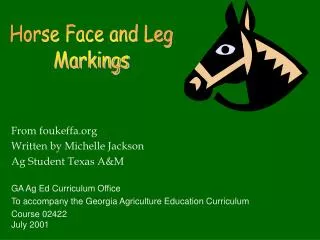
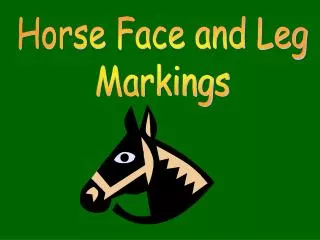
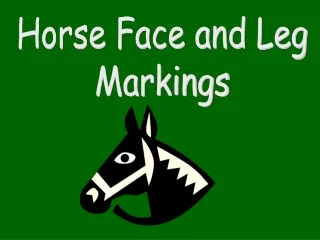
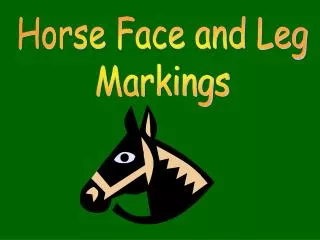
Horse Face and Leg Markings
OBJECTIVES • Student will be able to discuss the purpose of leg and facial markings • Student will be able to identify and describe four horse facial markings. • Students will be able to identify and describe six horse leg markings.
Star • White marking between eyes. • Comes in many shapes.
Stripe • Thin line down front of nose
SNIP • Small white fleck between nostrils.
BLAZE • Thick white line down front of nose. Horse also has a star.
BALD • Very wide blaze that extends to and may cover the eyes, nostrils, and upper lip. • Horses with bald faces often have white that extends to the lower lip as well.
SOCK • Small white marking up to and including the pastern.
WHITE HEEL • Small white marking on the heel, at the back of the hoof..
STOCKING • White marking finishing around the knee or hock.
HALF STOCKING • White marking that ends around half-way up the cannon bone.
CORONET BAND • Small white ring around the coronet band, above the hoof.
IRREGULAR STOCKING • Stocking that continues up the leg • Stocking that continues up the leg, but only partially.