WHMIS
WHMIS. Workplace Hazardous Materials Information System. “Right to Know”. Worker’s have access to information through their employer. Purpose of WHMIS. Provides Information on Hazardous Materials used in Workplace Facilitates the Process of Hazard Identification

WHMIS
E N D
Presentation Transcript
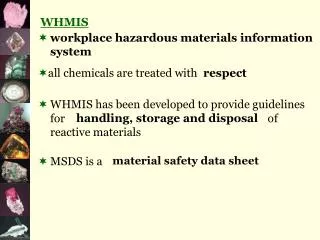
WHMIS Workplace Hazardous Materials Information System
“Right to Know” Worker’s have access to information through their employer.
Purpose of WHMIS • Provides Information on Hazardous Materials used in Workplace • Facilitates the Process of Hazard Identification • Ensures Consistency of Information in all Canadian Workplaces
Legislation Federal • Bill C-70 • Part of the Canada Labour Coded Provincial – Bill 79 • Ontario Reg. 644/88 • Occupational Health & Safety Act • Policed by Ministry of Labour
Exemptions From WHMIS • Explosives • Drugs • Pesticides • Radioactive Materials • Hazardous Wastes • Products being transported – T.D.G. Act • Consumer Products/Tobacco/Manufactured Articles
Three Components of WHMIS • Labels • Supplier Label • Workplace Label • Material Safety Data Sheets (MSDS) • Worker Education
Duties of the Supplier • Classify Product • Apply Supplier Label • Provide Material Safety Data Sheet • Update MSDS’s at least every 3 years
Duties of the Employer • Conduct Workplace Inventory • Ensure Proper Labeling is Used • Label Piping Systems/Vessels/Reactors • Maintain and Make Available MSDS’s • Train Workers
Duties of a Worker • Report missing or damaged labels or MSDS’s • Participate in Training • Apply Knowledge and Training
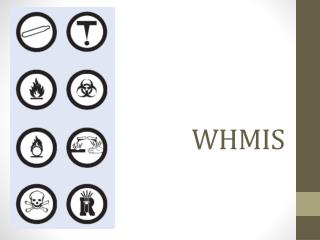
Class A • Compressed Gas • Any Hazardous Material that is contained under pressure including compressed gas, dissolved gas, or liquefied gas
Compressed Gas Cylinders • store and transport with safety cap • comply with storage restrictions • DO NOT store fuel gas with oxygen • secure in an upright position • use in a well ventilated area
Class B • Flammable and Combustible Material • Flammable Gases • Flammable and Combustible Liquids • Flammable Solids • Flammable Aerosols • Reactive Flammable Material • Methanol, Toluene, Butane, Acetone
Flammable Materials • Store liquids in Flammable Storage Cabinet • Explosion-proof fixtures required • NEVER store with oxidizers • Keep away from heat, ignition sources, and direct sunlight • Use static lines when transferring
Class C • Oxidizing Material • Any Hazardous Material which causes or contributes to the combustion of another material by giving oxygen or some other oxidizing substance, whether or not it is combustible. • Organic Peroxides • Chlorates, Nitric Acid, Peroxides, Permanganates, Perchlorates, Nitrites, Nitrates
Oxidizers • Easily oxidize metal powders, organic materials • Segregate from other materials, such as organic solvents • PPE and/or explosion barriers may be required
Class D1 • Poisonous & Infectious Materials • Material causing immediate and serious toxic effects • Materials which are potentially fatal or may cause permanent damage if inhaled, swallowed, or absorbed through the skin, or may burn the skin or eyes upon contact
Class D2 • Poisonous & Infectious Materials • Material causing other chronic or long term effects • Material which may • cause death or permanent damage as a result of repeated exposure over an extended period of time; • may be an irritant to the skin, eyes, or respiratory system; • may cause cancer, birth defects, or sterility.
Class D3 • Poisonous & Infectious Materials • Biohazardous and Infectious Materials • Materials which may cause disease in humans and animals, such as viruses, bacteria, and fungi; may also include cultures and diagnostic specimens such as blood, urine, and body tissue.
Class E • Corrosive Material • Material which may corrode aluminum and steel or human flesh • Material which are anhydrous corrosive gases
Inorganic Acids • Sulfuric Acid, Nitric Acid, Perchloric Acid, Hydrochloric Acid • Segregate from bases and organic compounds • Store in a ventilated acid cabinet • Know the location of eye washes and safety showers • Store on lower shelves
Bases • Sodium hydroxide, ammonium hydroxide • Segregate from acids and organic compounds • Store in a ventilated cabinet • Know the location of eye washes and safety showers • Store on lower shelves
Class F • Dangerously Reactive Material • Materials which undergo vigorous polymerization, decomposition, or condensation • Materials which become self-reactive under conditions of shock, or increased temperature or pressure • Materials which react vigorously with water to produce a very toxic gas
Supplier Label • Product Identifier • Hazard Symbols • Border • Bilingual • Risk Phrases and Precautions • First Aid • Safe Handling Precautions • Reference to MSDS • Supplier Information
Workplace Label • Product Identifier • Safe Handling Precautions • Reference to MSDS
Workplace Label Uses • Transfer of material from a Supplier Labelled container to another container • Replacement of a damaged Supplier Label
Hazardous Ingredients Preparation Information Fire & Explosion Hazard Toxicological Properties First Aid Measures Product Information Physical Data Reactivity Data Preventative Measures MSDS Contents