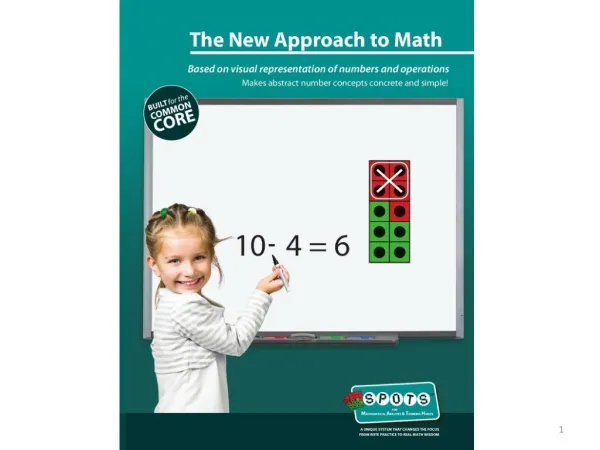
Spots Educational Resources
740 likes | 747 Vues
Presentation on the Spots for M.A.T.H. program


Spots Educational Resources
E N D
Presentation Transcript
Spots for M. A. T. H.™ Professional Development School Year ‘13-14
Agenda • Understanding the program philosophy • Getting acquainted with your material • Books • Teaching Materials • Practice Cards • Posters • Daily Routine Materials • Modeling a sample lesson • The Goal of the Common Core
Please park your questions. We will answer unanswered questions at the end.
Our Goal To help all students develop real math wisdom This includes: • An understanding of numbers and math concepts • The ability to manipulate numbers • The ability to make generalizations with mathematics • Fluency in basic math facts, which is so important for future math success • Proficiency in solving word problems
The Challenge How can we help our students become mathematical thinkers while teaching them to solve a problem like 9 - 6?
The Challenge • Math is a challenging abstract subject, built on concepts and strategies. It has its own language and a host of symbols: digits, >, <, operation symbols, etc. • How can we teach six-year-old children to manipulate numbers? • How can we teach so that children learn to make connections?
The Spots for M.A.T.H. Solution • Through the use of innovative tools: • Spots for M.A.T.H. Dot Cards • The Open Number Line • Puzzle-Piece Models for Solving Word Problems • A predictable and unique program progression • A progressive practice system We can help all students develop real math wisdom.
The Dot Cards Predictable images of numbers and operations, which are easy to visualize confidently,are used to overcome the abstract challenge.
Dot Cards 1-10 • These show the quantity of numbers 1-10, using black dots in a specific format. • 10 • 9 • 4 • 7 • 3 • 5 • 8 • 2 • 6 • 1 • 1 • 2 • 3 • 4 • 5 • 6 • 7 • 8 • 9 • 10
Teen Numbers Math educator Kathy Richardson has observed just how hard it is for children to understand the numbers 11 through 20 in terms of place value. She summarizes her many years of working with and observing children attempting this hurdle as follows: “Children who have not yet learned that numbers are composed of tens and ones think of the numerals that are used to write particular numbers as the way you 'spell' them.
Teen Numbers, cont’d. From the child's point of view, it just happens that we need a 1 and a 5 to write fifteen and a 1 and a 2 to write twelve. It is not obvious to young children that the numerals describe the underlying structure of the number” (p. 26). Richardson, K. (2003). Assessing Math Concepts: Ten Frames. Rowley, MA: Didax.
When and how are the Dot Cards used? • Teacher models the concept or strategy using Magnetic Dry-Erase Dot Boards with magnetic counters. • Students use Dot Boards and counters, and they practice in their book. • Then the concept-representation Dot Cards are used in lesson warm-ups for practice and reinforcement.
Magnetic Dry-Erase Dot Boards with black-and-white magnetic counters
Modeling a Concept with Magnetic Dry-Erase Dot Boards and Magnetic Counters • 7 - 1 = 6 • 7 + 2 = 9
Modeling a Concept with Magnetic Dry-Erase Dot Boards and Magnetic Counters • The make-a-ten strategy • 9 + 8 = 17
Modeling the Concept with Magnetic Dry-Erase Dot Boards • 13 - 5 = 8
Addition Dot Cards 1-10 • The greater addend is shown first, with black dots; the lesser addend is shown second, with white dots. • 3 + 1 = 4 • 4 + 2 = 6 • 6 + 4 = 10 • 5 + 3 = 8
Subtraction Dot Cards 1-10 • The subtrahend (the number subtracted) is shown by circling and crossing off the appropriate number of dots. • When it is a small number, the dots are crossed off the top. • 9 – 2 = 7 • 10 – 1 = 9
Subtraction Dot Cards 1-10 • When the subtrahend is a large number, the dots are crossed off the bottom. • 9 – 7 = 2 • 7 – 6 = 1
Teen Addition Dot Cards • Used for addition with teen sums to 19. The greater addend is shown first, with black dots; the lesser addend is shown second, with white dots. • 9 + 5 = 14 • 8 + 7 = 15
Teen Subtraction Dot Cards • When subtracting a small number, dots are crossed off starting from the “ones side.” • 13 - 4 = 9 • 14 - 6 = 8
Teen Subtraction Dot Cards cont. When subtracting a large number (10, 9, 8, and some-times 7), they are crossed off from the “tens side.” • 13- 9 = 4 • 14 – 8 = 6
FAQ • Must children cross off dots the way we tell them to? • What if a student of mine will want to cross off dots differently? • What does “sometimes 7” mean? Why not all the time?
Using the Number Line to Extend Thinking Strategies to Two Digit Numbers and Beyond When it comes to calculating with larger numbers mentally, it becomes hard to visualize the amounts, as we must think of quantity images of all the tens and ones we had, and then how many we are adding on. At this point it’s much more helpful to think of a number line beginning at a specific point, and then jumping by tens and by ones.
Using the Number Line cont. There is much research showing that the brain actually thinks of the larger units first; that is, if you would ask a student to solve two-digit addition before he or she was taught a formal process for such equations, the child would think of the tens first! The algorithm actually asks us to work against our understanding of numbers! So its crucial to first develop number sense and the ability to calculate mentally, and then to transfer it to the algorithm – the formal paper and pencil process. • Number line Classroom Banner 1-100
The Program Progression Students see clearly how one skill builds on another. • 6 - 5 = 1 • 6 - 2 = 4 • 6 - 1 = 5 • 6 + 3 = 9 • 6 + 1 = 7
The Program Progression Predictability and patterns help students generalize strategies
The Program Progression Concepts are built and layered over time. • Chapter 5: Decade Numbers • Chapter 6: Two-Digit Numbers • Chapter 4: Teen Numbers
The Program Progression, cont’d. Money skills are inserted throughout the chapters as a problem solving application of the concepts presented. This helps teach students to generalize skills.
The Practice System Lesson Warm-Up with Form #1
The Practice System, cont’d. Lesson Warm-Up with Form #2
The Practice System, cont’d. Lesson Warm-Up with Form #3 4 + 2 5 + 3
The Practice System, cont’d. Double-Sided Number Sentence Wipe-Off Boards
Maximizing the Learning Experience • The daily routine • Ongoing visual reinforcement • Banners • Math window • Teacher’s Resource Book
Daily Routine Material • Spots for M. A. T. H. Magnetic Money House • Hundred Number Pocket Chart with 100 Clear Pockets, Pattern Markers
Teacher’s Resource Book The Resource Book is a 148-page binder that provides copy masters for teachers to use throughout the year. It includes: • Family letters (to keep the families informed of and involved in all that the class is learning) • Drop-Its forms (used in the lesson warm-up section to develop fluency and for ongoing assessment) • Cutouts (drawings that are meant to be cut, for the teacher to use, such as a frog cutout to model jumping on the number line) • Lesson Handouts (which are used by students to enhance the lessons) • Assessment Forms • Reproducible Game Cards and Boards