Introduction to Statistics for Social Sciences | Lecture Schedule & Study Guide
300 likes | 417 Vues
Join the statistics lecture series covering z-scores, probability, raw data analysis, and more. Get your study guide for upcoming exams and readings.


Introduction to Statistics for Social Sciences | Lecture Schedule & Study Guide
E N D
Presentation Transcript
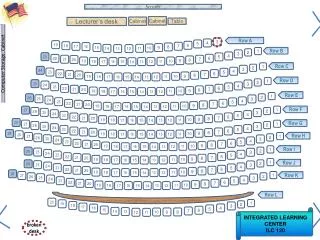
Screen Cabinet Cabinet Lecturer’s desk Table Computer Storage Cabinet Row A 3 4 5 19 6 18 7 17 16 8 15 9 10 11 14 13 12 Row B 1 2 3 4 23 5 6 22 21 7 20 8 9 10 19 11 18 16 15 13 12 17 14 Row C 1 2 3 24 4 23 5 6 22 21 7 20 8 9 10 19 11 18 16 15 13 12 17 14 Row D 1 2 25 3 24 4 23 5 6 22 21 7 20 8 9 10 19 11 18 16 15 13 12 17 14 Row E 1 26 2 25 3 24 4 23 5 6 22 21 7 20 8 9 10 19 11 18 16 15 13 12 17 14 Row F 27 1 26 2 25 3 24 4 23 5 6 22 21 7 20 8 9 10 19 11 18 16 15 13 12 17 14 28 Row G 27 1 26 2 25 3 24 4 23 5 6 22 21 7 20 8 9 29 10 19 11 18 16 15 13 12 17 14 28 Row H 27 1 26 2 25 3 24 4 23 5 6 22 21 7 20 8 9 10 19 11 18 16 15 13 12 17 14 Row I 1 26 2 25 3 24 4 23 5 6 22 21 7 20 8 9 10 19 11 18 16 15 13 12 17 14 1 Row J 26 2 25 3 24 4 23 5 6 22 21 7 20 8 9 10 19 11 18 16 15 13 12 17 14 28 27 1 Row K 26 2 25 3 24 4 23 5 6 22 21 7 20 8 9 10 19 11 18 16 15 13 12 17 14 Row L 20 1 19 2 18 3 17 4 16 5 15 6 7 14 13 INTEGRATED LEARNING CENTER ILC 120 9 8 10 12 11 broken desk
Introduction to Statistics for the Social SciencesSBS200, COMM200, GEOG200, PA200, POL200, or SOC200Lecture Section 001, Fall, 2013Room 120 Integrated Learning Center (ILC)10:00 - 10:50 Mondays, Wednesdays & Fridays. Welcome http://www.youtube.com/watch?v=oSQJP40PcGI
Homework due – Wednesday (October 9th) On class website: Please print and complete homework worksheet #11 Calculating z-score, raw scores and areas under normal curve Please click in My last name starts with a letter somewhere between A. A – D B. E – L C. M – R D. S – Z
Use this as your study guide By the end of lecture today10/4/13 Counting ‘standard deviationses’ – z scores Connecting raw scores, z scores and probabilityConnecting probability, proportion and area of curve Percentiles
Schedule of readings Before next exam (October 18th) Please read chapters 5, 6, & 8 in Ha & Ha Please read Chapters 10, 11, 12 and 14 in Plous Chapter 10: The Representativeness Heuristic Chapter 11: The Availability Heuristic Chapter 12: Probability and Risk Chapter 14: The Perception of Randomness
Lab sessions Labs continue next week with Project 1
One positive correlation One negative correlation One t-test
Remember… In a negatively skewed distribution: mean < median < mode 88 = mode = tallest point 84 = median = middle score 80 = mean = balance point Mode Frequency Score on Exam Mean Note: Always “frequency” Median Note: Label and Numbers
Homework Worksheet Examples of the seven prototypical designs
Class standing 4 Ordinal # Bags Sold Quasi # of bags of peanuts sold Ratio Between One-way ANOVA Fr So JrSr Class Standing
Homework Review Average # of bags of peanuts sold Frequency 95% Confidence Interval Average # of bags of peanuts sold
Homework Review Type of Diet 2 Nominal Weight Loss True Experiment Weight Loss Ratio Between Regular New T-test Type of Diet
Homework Review Type of Diet Male 2 Gender Weight Loss 2 Female Mixed Weight Loss Regular New Between Type of Diet Two-way ANOVA
Homework Review Distance Time Strong, positive +1.0 Correlation Time Distance
Raw scores, z scores & probabilities The normal curve is defined mostly by its mean, and standard deviation. Once we know that we can figure out a lot z-table (from z to area) Distance from the mean ( from raw to z scores) Raw Scores (actual data) Proportion of curve (area from mean) Given any of these values (raw score, area, z score) and you can figure out the other two.
Scores, standard deviations, and probabilities Mean = 50 S = 10 (Note S = standard deviation) If we go up one standard deviation z score = +1.0 and raw score = 60 If we go down one standard deviation z score = -1.0 and raw score = 40
Scores, standard deviations, and probabilities Mean = 50 S = 10 (Note S = standard deviation) If we go up two standard deviations z score = +2.0 and raw score = 70 If we go down two standard deviations z score = -2.0 and raw score = 30
Scores, standard deviations, and probabilities Mean = 50 S = 10 (Note S = standard deviation) If we go up three standard deviations z score = +3.0 and raw score = 80 If we go down three standard deviations z score = -3.0 and raw score = 20
z scores z score: A score that indicates how many standard deviations an observation is above or below the mean of the distribution z score = raw score - mean standard deviation
Find z score for raw score of 60 z score: A score that indicates how many standard deviations an observation is above or below the mean of the distribution z score = raw score - mean standard deviation z-table (from z to area) Distance from the mean ( from raw to z scores) Raw Scores (actual data) Proportion of curve (area from mean) 50 60 z = 1 10 Mean = 50 S = 10 (Note S = standard deviation)
Find z score for raw score of 30 z score: A score that indicates how many standard deviations an observation is above or below the mean of the distribution z score = raw score - mean standard deviation z-table (from z to area) Distance from the mean ( from raw to z scores) Raw Scores (actual data) Proportion of curve (area from mean) 50 30 z = - 2 10 Mean = 50 S = 10 (Note S = standard deviation)
Find z score for raw score of 70 Raw scores, z scores & probabilities z-table (from z to area) Distance from the mean ( from raw to z scores) If we go up to score of 70 we are going up 2.0 standard deviations Raw Scores (actual data) Proportion of curve (area from mean) Then, z score = +2.0 z score = raw score - mean standard deviation z score = 70 – 50 . 10 = 20. 10 = 2 Mean = 50 S = 10 (Note S = standard deviation)
Find z score for raw score of 80 z score: A score that indicates how many standard deviations an observation is above or below the mean of the distribution z score = raw score - mean standard deviation z-table (from z to area) Distance from the mean ( from raw to z scores) Raw Scores (actual data) Proportion of curve (area from mean) 50 80 z = 3 10 Mean = 50 S = 10 (Note S = standard deviation)
Find z score for raw score of 20 Raw scores, z scores & probabilities z-table (from z to area) Distance from the mean ( from raw to z scores) If we go down to score of 20 we are going down 3.0 standard deviations Raw Scores (actual data) Proportion of curve (area from mean) Then, z score = -3.0 z score = raw score - mean standard deviation z score = 20 – 50 10 = - 30 . 10 = - 3 Mean = 50 S = 10 (Note S = standard deviation)
z scores - Writing Assignment 1. In this formula, what does this symbol refer to? • What is it called? • What does it mean? • Is it a parameter or statistic? 2. In this formula, what does this symbol refer to? • What is it called? • What does it mean? • Is it a parameter or statistic? 3. In this formula, what does this symbol refer to? • What is it called? • What does it mean? • Is it a parameter or statistic? 4. In this formula, what does this symbol refer to? • What is it called? • What does it mean? • Is it a parameter or statistic? 5. In this formula, what does this symbol refer to? 6. What is a z score?
z scores - Writing Assignment 1. In this formula, what does this symbol refer to? The standard deviation (population) sigma • What is it called? • What does it mean? • Is it a parameter or statistic? parameter 2. In this formula, what does this symbol refer to? The mean (population) mu • What is it called? • What does it mean? • Is it a parameter or statistic? parameter The mean (sample) 3. In this formula, what does this symbol refer to? x-bar • What is it called? • What does it mean? • Is it a parameter or statistic? statistic 4. In this formula, what does this symbol refer to? The standard deviation (sample) s • What is it called? • What does it mean? • Is it a parameter or statistic? statistic Raw score that you are changing into a z-score The number of standard deviations you are from the mean 5. In this formula, what does this symbol refer to? 6. What is a z score?
Thank you! See you next time!!