Mild Steel Flanges
E N D
Presentation Transcript
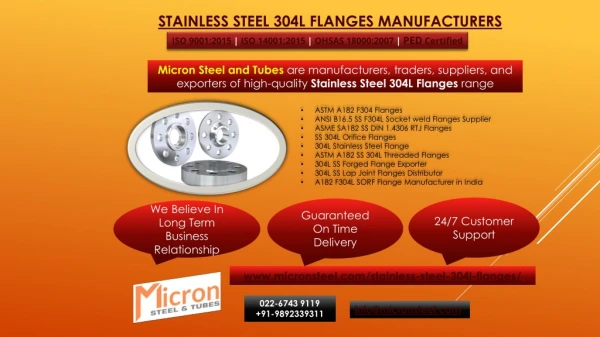
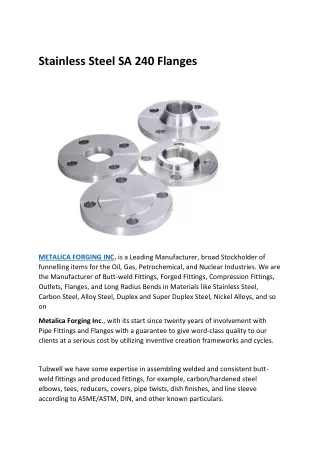
Introduction to Mild Steel Flanges Mild steel flanges are circular plates with holes for connecting pipes, valves, pumps, and other equipment in piping systems. They facilitate the joining of two sections of pipe, allowing for the easy assembly and disassembly of piping. Commonly used in various industries, mild steel flanges are renowned for their durability, affordability, and ease of welding, making them ideal for applications in oil and gas, petrochemicals, and power generation plants.
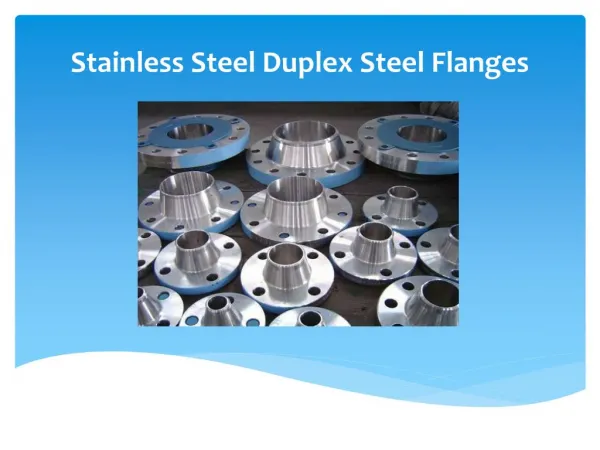
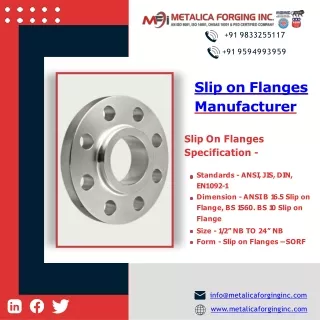
Types of Mild Steel Flanges Mild Steel Blank Flanges Mild Steel Slip On Flanges Mild Steel Weld Neck Flanges Used to seal the end of pipes, blank flanges provide a smooth surface for easy installation and can withstand high pressure. These flanges slide over the pipe and are welded in place, ideal for lower pressure applications due to their ease of installation. Designed for high-pressure applications, these flanges have a long neck that helps with alignment and is welded to the pipe. Mild Steel Blind Flanges Mild Steel Exhaust Flanges Mild Steel Raised Face Flanges Typically used in automotive applications, these flanges connect exhaust systems, allowing for easy assembly and disassembly. Used to close off the ends of piping systems, blind flanges do not have a hole, providing a secure seal. These flanges have a raised area around the bore that increases the contact area for better sealing under pressure.
Key Specifications of Mild Steel Flanges Sizes Available Pressure Classes Mild steel flanges are available in sizes from ½” to 12”, covering nominal pipe sizes (NPS) from 15NB to 800NB. These flanges are categorized into various pressure classes including PN6 and PN16, suitable for different operating conditions. Melting Point Range Available Schedules The melting point of mild steel flanges typically ranges from 1350 °C to 1530 °C, allowing for high- temperature applications. Mild steel flanges are available in several schedules including SCH 10, SCH 20, SCH 40, and up to SCH 160 for various thicknesses.
Advantages of Using Mild Steel Flanges Pros Easy to weld, allowing for quick assembly and reduced labor costs in construction and maintenance. ● Versatile applications across various industries, including oil and gas, petrochemicals, and construction. ● Recyclable material that supports sustainable practices and reduces environmental impact. ● Low carbon content enhances ductility and weldability, making them suitable for various engineering applications. ● Excellent electrical and thermal conductivity, beneficial in systems requiring effective energy transfer. ● Cons Susceptible to corrosion if not properly coated or maintained, potentially leading to structural failure. ● Lower strength compared to other alloyed steels, which may limit use in high-stress applications. ● Limited performance in extreme temperatures compared to specialized materials. ● Not suitable for highly corrosive environments without additional protective measures. ● Potential for warping during welding if not handled correctly. ●
Chemical Composition of Mild Steel Flanges Manganese Iron Manganese content is typically around 1.03%. It enhances the strength and wear resistance of mild steel. Iron is the primary component, making up approximately 98.0% of the composition, providing the structural integrity. Sulfur Carbon Sulfur content is limited to 0.050%, as it can negatively affect the steel's ductility. Carbon is present in the range of 0.25% to 0.290%, influencing the hardness and strength of mild steel.
Applications of Mild Steel Flanges Nuclear Energy Sector Mild steel flanges are utilized in the piping systems of nuclear power plants, ensuring secure connections that handle high-pressure and temperature environments. Petrochemical Industry These flanges are essential in petrochemical refineries, providing reliable connections for transporting various chemicals and fluids under extreme conditions. Power Generation Plants In power generation facilities, mild steel flanges are commonly used in steam and water pipelines, contributing to the efficiency and safety of energy production.
Contact and Additional Information For inquiries regarding mild steel flanges, please contact us via email at info@rameshgroup.com. • For immediate assistance, reach us at +91- 9819806035 (WhatsApp available). • Visit our website for product details and resources: www.rameshgroup.com. • Our registered office is located at: Ramesh Steel Corporation, 89, 2nd Pathan Street, Maruti Mandir Marg, 5th Kumbharwada, Mumbai - 400004, Maharashtra, India. •