Lawmaking
This overview explores the intricacies of the lawmaking process in the U.S., highlighting how bills—whether public, private, or appropriation—are created and passed. It illustrates the journey a proposed law takes from introduction, committee scrutiny, debate, and voting in Congress to the president's desk. With a focus on the importance of clear language and the challenges in passing legislation, it reviews the voting methods employed in Congress and the factors that contribute to the low number of bills that become law each year.

Lawmaking
E N D
Presentation Transcript
Lawmaking Mr. Rhodes
“I’m Just a Bill” • Bill- proposed new law or an amendment to an already existing law. • Law- A bill or act passed by the legislative body.
Most ideas for bills come from the ideas of everyday citizens!!!!!!!!!!
Types of Bills • Public Bill- Apply to the nation as a whole. Ex. Civil Rights Act of 1964 • Private Bill- Apply to certain persons or places rather than an entire nation. Ex. Congress passed an act to give an Idaho sheep rancher $85,000 for his losses resulting from attacks by grizzly bears which had been moved nearby.
Types of Bills • Appropriation Bill- legislative motion that allows the government to spend money. Ex. Defense spending to support troops in Iraq.
Writing a Bill • It is important that when a bill is written that proper language is used. • There is a push to now write laws in more simplistic language. However, many laws are still written in a language that is too complex to understand.
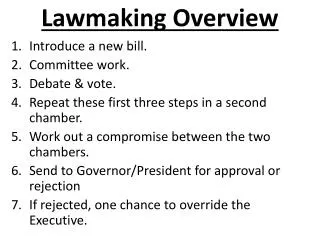
What Needs To Happen For A Bill To Pass To A Law? • Once a bill passes through the House and the Senate committees it goes to the floor. • Once on the floor a debate begins. • After the debate there is a vote. Majority rules. • It then goes to the president and if he signs off it the bill becomes a law. • If he the president gives the bill a veto it can stay alive with a 2/3 vote.
The Debate • House of Representatives • Short and Sweet • Senate • Much more time. Members can block legislation • Filibuster- prolonged debate or other delaying tactics aimed at blocking the passage of a bill favored by a majority of lawmakers…can go on for days. • Hold- signals the intention to launch a filibuster • Cloture- supermajority (2/3 vote can cut off the debate)
Ways Congress Votes • Voice Vote • All together call out aye (yes) or no • Standing Vote • Stand to be counted • Roll Call Vote • Each member’s vote if officially recorded
About 5,000 bills are introduced in Congress every year, but only about 150 are signed into a law. Why do you think so few bills become a law? Is that a good thing or a bad thing? Should the lawmaking process be reformed? What changes would you recommend?
School House Rock • I’m Just a Bill