Cationic Comb Polymer Superdispersants Enhance Stability of Colloidal Silica Suspensions
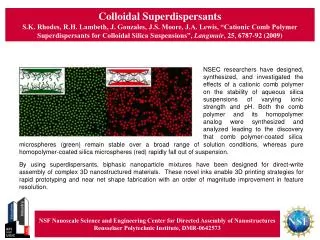
Researchers at the NSF Nanoscale Science and Engineering Center for Directed Assembly of Nanostructures at Rensselaer Polytechnic Institute have developed cationic comb polymer superdispersants to improve the stability of aqueous silica suspensions. This study highlights that comb polymer-coated silica microspheres exhibit stability across various ionic strengths and pH levels, unlike their homopolymer counterparts. The findings enable the creation of novel nanoparticle mixtures for direct-write assembly, significantly enhancing 3D printing capabilities with improved resolution for complex nanostructured materials.

Cationic Comb Polymer Superdispersants Enhance Stability of Colloidal Silica Suspensions
E N D
Presentation Transcript
NSF Nanoscale Science and Engineering Center for Directed Assembly of Nanostructures Rensselaer Polytechnic Institute, DMR-0642573 Colloidal Superdispersants S.K. Rhodes, R.H. Lambeth, J. Gonzales, J.S. Moore, J.A. Lewis, “Cationic Comb Polymer Superdispersants for Colloidal Silica Suspensions”, Langmuir, 25, 6787-92 (2009) NSEC researchers have designed, synthesized, and investigated the effects of a cationic comb polymer on the stability of aqueous silica suspensions of varying ionic strength and pH. Both the comb polymer and its homopolymer analog were synthesized and analyzed leading to the discovery that comb polymer-coated silica microspheres (green) remain stable over a broad range of solution conditions, whereas pure homopolymer-coated silica microspheres (red) rapidly fall out of suspension. By using superdispersants, biphasic nanoparticle mixtures have been designed for direct-write assembly of complex 3D nanostructured materials. These novel inks enable 3D printing strategies for rapid prototyping and near net shape fabrication with an order of magnitude improvement in feature resolution.