Comprehensive IDELA Assessment Tool for Early Learning
270 likes | 301 Vues
Learn about IDELA, a play-based assessment tool for children aged 3-6 to measure developmental domains and learning approaches across various languages. Find out its applications, domains, sample questions, and global partnerships.


Comprehensive IDELA Assessment Tool for Early Learning
E N D
Presentation Transcript
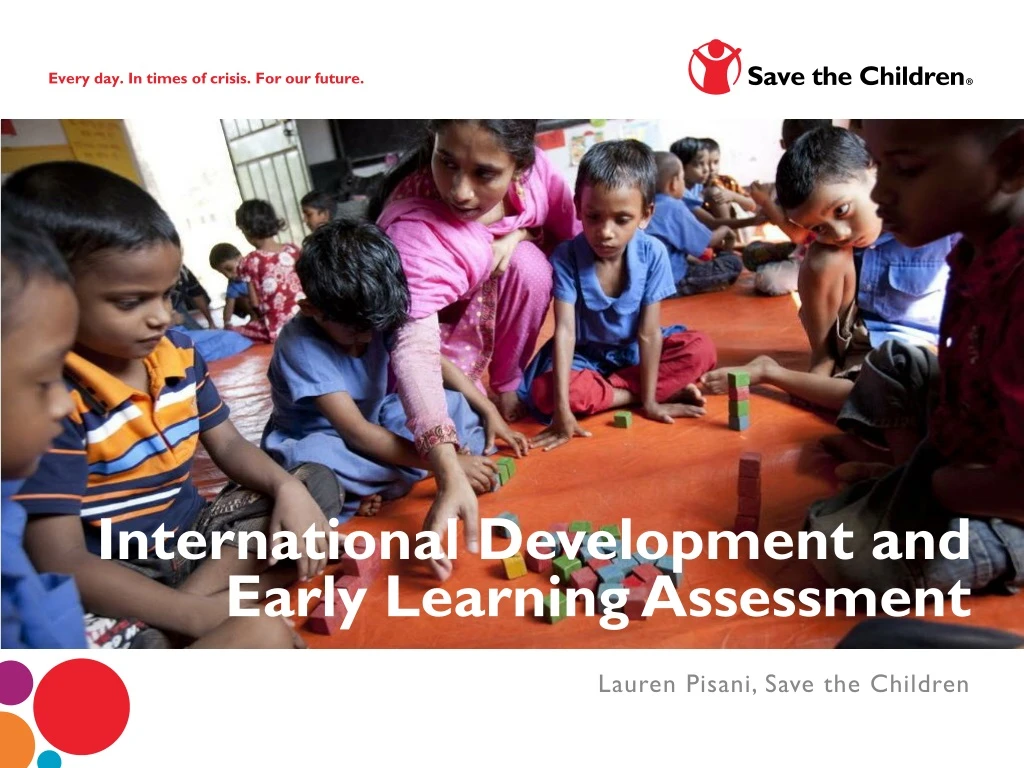
International Development and Early Learning Assessment Lauren Pisani, Save the Children
Save the Children’s Global ECCD Portfolio Work in over 75 countries around the globe Directly reach close to 2 million children per year and indirectly touch the lives of over 10 million children Support a wide range of programs – Home/Community/School based, Parent Education, Intensive Summer Programs, and more
International Development and Early Learning Assessment (IDELA): 3 Pillars
IDELA Overview • Play-based assessment tool designed for children in the 3-6 age group • Takes about 30 minutes per child • Includes 22 core items that cover 4 developmental domains + learning approaches and aspects of executive function • Emphasizes continuous scoring over yes/no responses • Available in English, Spanish, French, Arabic, and many other languages
Simple adaptation and administration across settings • Minimal administration materials Children’s book, pencil, paper, and small objects for counting, 8 picture cards • Adaptation of materials and items is important part of the process of introducing the tool to new sites • Administration, adaptation and training manuals standardize the use of the tool across sites • Assessors do not need to be child development experts • Tablets or paper & pencil can be used
IDELA Domains & Skills Learning Approaches Executive Function
Sample Question: Fine Motor Development Give the pencil and paper to the child and say “I have another drawing game for you. Please draw a picture of a girl or a boy standing up.”
Sample Question: Emergent Literacy – Letter identification • What letter is this?
Sample Question: Emergent Math - One-to-One Correspondence • Materials:20 small items (e.g. stones/blocks/beans etc.) • Now we are going to play with bottle caps. Here are some bottle caps. Can you please give me 3? • Re-arrange the 20 bottle caps randomly againandsay: • Thanks. Now, can you please give me 7 bottle caps? • If the child cannot give you 3 or 7 objects, stop and move on to the next item. • Can you please give me 15 bottle caps?
Sample Question: Social-Emotional Development • Perspective Taking/Empathy • Materials: Picture card of a girl crying • Show the picture card and say, • Now let’s look at this picture. How do you think this child is feeling right now? • Then ask,What would you do to help her feel better? • Prompt ONCE by asking, Is there anything else you would do to make her feel better? [
IDELA Globally • IDELA Used • IDELA Planned • MELQO Partnership
IDELA Use: Cross-country comparability and global attention • Global (MELQO) • Brookings Institution, UNICEF, UNESCO, World Bank • World Bank • Slovakia, Bulgaria, Romania, • Budapest – 12 country training to get comparative outcomes • Universities • New York University (psychometric analysis & Ghana), • Aga Khan University (Pakistan), • Yale University (Colombia), • UniNorte (Colombia), • University of Zambia • Technical Providers • Roma Education Fund(Balkan Region) • Ubongo (Tanzania), • RTI (Kenya), • AIR (Bangladesh), • EQUIP (Tanzania), • IECD for Young Children Affected by HIV and AIDS (Kenya), • International Rescue Committee (Lebanon) • Tembo (Nigeria) • FSG (India)
Thank you! lpisani@savechildren.org