Understanding Information Systems: Components, Functions, and Organizational Impact
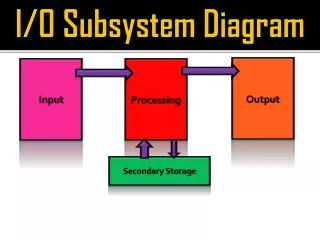
This guide explores the essential concepts of information systems, including the input, process, output, and feedback functions that make up a system. It discusses the interrelated components within an organization, including customers, suppliers, stockholders, and competitors, and how they contribute to achieving desired outcomes. Using examples like beverage production and retail systems, it breaks down the inputs, processes, and outputs involved in these systems. The document also addresses the critical skills and knowledge required for system analysts in managing technological and organizational needs.

Understanding Information Systems: Components, Functions, and Organizational Impact
E N D
Presentation Transcript
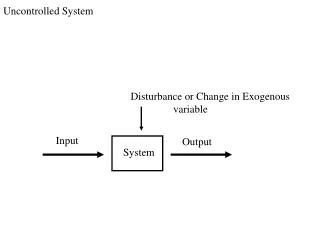
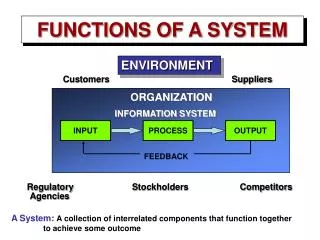
INFORMATION SYSTEM INPUT PROCESS OUTPUT FEEDBACK FUNCTIONS OF A SYSTEM ENVIRONMENT Customers Suppliers ORGANIZATION Regulatory Stockholders Competitors Agencies A System:A collection of interrelated components that function together to achieve some outcome
System Example: A Beverage Inputs + • Malt • Sugar • Barley • Water • Formaldehyde • Case • Labour • Capital Processing = • Brew • Ferment • Filter • Bottle • Cap Output • Cases of Beverages Functional Breakdown?
System Functional BreakdownFutureshop Inputs + Products People Capital Etc. Processing = • Selling Output • Sold Product Functional Breakdown? What functions occur inside Futureshop to make selling happen? What are the components necessary for a Futureshop store?
SYSTEM ANALYSTYour Job! Boundary INTERDEPENDENCE HARDWARE BUSINESS Strategy Rules Procedures SOFTWARE DATABASE TELE-COMMUNICATIONS ORGANIZATION INFORMATION SYSTEM System? Subsystem? Supersystem?
ESS MIS DSS TPS DIFFERENT TYPES OF INFORMATION SYSTEMS OAS
Technical Knowledge Computer hardware Computer software Networking Programming Operating systems Tools Database systems IDEs (VB, Java, FrontPage) Prototype and RAD tools for mach ups Documentation, testing, revision & project management tools etc. Techniques Project management System analysis System design System construction / implementation System support Business and People Knowledge What the org. does, its structure, and functional areas Management and power structure Strategic focus Communication skills Problem realization and solving System Analyst Skills(short list!)
Next Class • Rocky Mountain Outfitters • May start chapter 2.
Rocky Mountain Concepts • Supply chain management (SCM) • Customer support system (CSS) • Customer relationship/resource management (CRM) • Application architecture plan: a description of the integrated IS that the organization needs to carry out its business function. • Technology architecture plan: a description of the HW SW and networks required to implement planned IS.
Rocky Mountain Issues/Points • Give a synapses of RMO. • Want to implement CRM and SCM: book focus is on the CRM: KSF • Many systems are >10 yrs. old: Legacy • Details of the Technology and applications architecture plan.