Securing LAN Traffic: Address Flooding, Port Security, and 802.1X Authentication Techniques
170 likes | 288 Vues
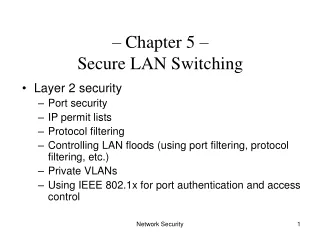
This chapter delves into crucial techniques for securing Local Area Networks (LANs). It addresses MAC address flooding, which can lead to Content Addressable Memory (CAM) overflow and Denial of Service (DoS) attacks. It covers how to configure port security, restrict access via IP permit lists, and control broadcast traffic. Furthermore, it discusses the implementation of Private VLANs and the IEEE 802.1X standard for device authentication. The chapter outlines the roles of supplicants, authenticators, and authentication servers in the authentication process, utilizing Extensible Authentication Protocol (EAP) for secure communication.


Securing LAN Traffic: Address Flooding, Port Security, and 802.1X Authentication Techniques
E N D
Presentation Transcript
MAC Address Flooding Causing CAM Overflow and Subsequent DOS and Traffic Analysis Attacks
Port Security • Example • Set port security 2/1 enable • Set port security 2/1 00-90-2b-03-34-08 • Set port security 3/2 maximum 1
Restricting Access to a Switch via IP Permit List • Example • Set ip permit enable • Set ip permit 172.16.0.0 255.255.0.0 telnet • Set ip permit 172.20.52.2 255.255.255.255 snmp • Set ip permit 172.20.52.3 all
Controlling LAN Floods • Example • Set port broadcast 2/1-6 75%
Private VLANs on the Catalyst 6000 • Restricts intra VLAN traffic on a per port basis • Solves ARP spoofing
IEEE 802.1x Standard • Provides authentication of devices connecting to a physical port on a layer 2 switch or a logical port on a wireless access point
802.1x Entities • Supplicant: a device (eg. Laptop) that needs to access the LAN • Authenticator: a device that initiates the authentication process between the supplicant and the authentication server • Authentication server: a device (eg. Cisco ACS) that can authenticate a user on behalf of an authenticator
802.1x Communication • Uses Extensible Authentication Protocol (EAP) described in RFC 3748 • Authentication data is transmitted in EAP packets • encapsulated in EAPOL frames between supplicant and authenticator • encapsulated TACACS+ or RADIUS packets between authenticator and authentication server
Extensible Authentication Protocol (EAP) • Carries authentication data between two entities that wish to set up an authenticated channel for communication • Supports one-time password, MD5 hashed username and password, and transport layer security
EAP Packet Format (RFC 2284) • Code: identifies EAP packet type such as request, response, success, or failure • Identifier: used to match responses with requests • Length: length of EAP packet
Types of EAP Request/Response messages • Identity message • Notification message • NAK message • MD-5 challenge message • One-time password message • Transport-Layer Security (TLS) message
Relationship between Supplicant, Authenticator, Authentication server, EAPOL, and TACACS+/Radius
802.1x Architecture and Flow using EAP over EAPOL and EAP over TACACS+/RADIUS