Rise and Collapse: Early Greek Civilizations
170 likes | 281 Vues
Explore the geography, trade, and conflicts of Early Greeks, from Minoans to Dorians, shaping the birth of city-states and citizenship in ancient Greece.


Rise and Collapse: Early Greek Civilizations
E N D
Presentation Transcript
The Early Greeks Chapter 4 Section 1 Pg. 116-123
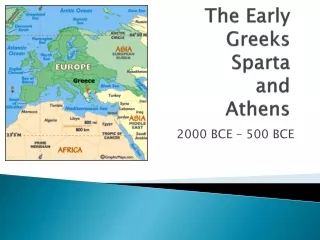
The Geography of Greece • The mainland Greece is a peninsula meaning a body of land with water on each side • To the west is the Ionian Sea • To the south is Mediterranean Sea • To the east is Aegean
Early Greek • Made their living by the sea • They became fishers, sailors, and traders. • Others made their living by farming • Growing wheat, barley, olives and grapes • They also raised sheep and goats
Minoans • Minoans were note Greek but their civilization was the first to arise in the region that later became Greece • They made their wealth from trade. • They built ships from oak and cedar and sailed as far as Egypt and Syria • They traded pottery & stone vases for ivory & metal • Their ships controlled the eastern Mediterranean Sea
Minoans • About 1450 B.C. Minoan civilization suddenly collapsed. • Some believe by undersea earthquakes causing giant waves. • Others believe the cities were destroyed by a group of Greeks from the mainland called the Mycenaeans
The First Greek Kingdoms • The Mycenaeans were originally from central Asia • The Mycenaean leaders became the first Greek kings • They would pay their taxes in wheat, livestock, and honey and stored them in the place.
Mycenaeans learned from the Minoan • Mycenaeans began trade with the Minoan • As a result they learned much from their culture • How to work with bronze • How to build ships • How to navigate by the sun and stars. • They began worshiping the Earth Mother, the Minoans’ chief goddess
Dark Ages • By 1200 B.C the Mycenaeans began to crumble • Eathrquakes and fighting among the kingdoms destroyed their hilltop forts. • By 1100 B.C their civilization had collapsed.
Dark Ages • Between 1100 B.C. and 750 B.C. was difficult for the Greeks. • Overseas trade slowed and poverty took hold • Farmers grew only enough for their family • They stopped teaching others to wrist and do craftwork • They forgot the written language and how to do things
The good of the Dark Ages • Greek culture began to expand. • Thousands of Greeks left the mainland and settled in the islands in the Aegean Sea • Others moved to the shores of Asia Minor
Dorians • Dorians lived in the northern mountains of Greece and began to move south during the Dark ages • They brought iron weapons giving the Greece more advanced technology • Iron weapons and farm tools were stronger and cheaper than those made from bronze • Farms began to produce food again and trade revived
Alphabet • Because of trade a new way of writing was obtained • The Greeks picked up the idea of an alphabet from the Phoenicinas. • The Greek alphabet had 24 letters that stood for sounds. • Making reading and writing more simpler than ever
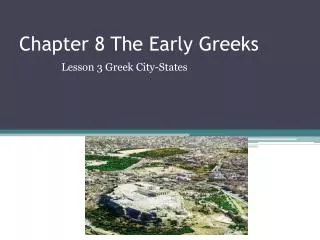
City-State • The nobles created city-states after overthrowing the Greek Kings. • Each Greek city-state known as a polis was like a tiny independent country • The polis would have a main gathering place usually on the top of a hill called acropolis. • Acropolis were used as a safe refuge and as a religious center.
City-State continue • Below the acropolis would be an open area called agora. • This had two functions • A market • A place where people could meet and debate issues
Citizenship • Greeks were the first people to develop the idea off citizenship. • Each city-state was run by its citizens • These were political community who treat each other as equals and who have rights and responsibilities • Most Greek city-states citizens could only be free native-born men who owned land. • Some city-states allowed women and children to be citizens but they had no rights.
Rights of a Citizen • They could gather in the agora • Choose their officials • Pass laws • Right to vote • Hold office • Own property • Defend themselves in court • In return they had to serve in government and fight for their polis as citizen soldiers
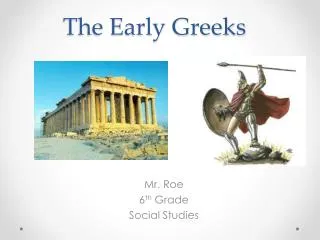
Hoplites • Early Greek wars were fought by nobles riding horses and chariots • The development of citizenship changed the military system • City-states depend on armies of ordinary citizens called hoplites • They would march into battle on foot with a round shield, a short sword, and 9-foot spear. • Hoplites made good soldiers because they took pride and fighting for their city-state • However this hometown loyalties divided the Greeks and caused them to destroy one another.