HDRI Capture and Response Curve Recovery Utilizing Multiple Exposures
This document outlines the process of capturing High Dynamic Range Imaging (HDRI) using multiple exposures to obtain a response curve. It delves into the mathematical concepts behind response curve recovery, including solutions for overdetermined systems, least-squares solutions, and the utilization of Singular Value Decomposition (SVD). The emphasis is on combining pixel data to minimize noise and enhance reliability in radiance mapping. Various software libraries, algorithms for alignment, and optimization methods are detailed, aiming to improve image quality in graphics applications.

HDRI Capture and Response Curve Recovery Utilizing Multiple Exposures
E N D
Presentation Transcript
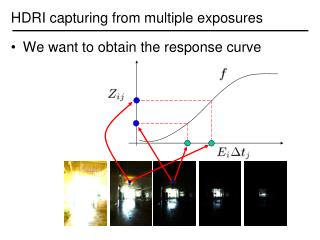
HDRI capturing from multiple exposures • We want to obtain the response curve
HDRI capturing from multiple exposures Image series • 1 • 1 • 1 • 1 • 1 • 2 • 2 • 2 • 2 • 2 • 3 • 3 • 3 • 3 • 3 Dt =2 sec Dt =1 sec Dt =1/2 sec Dt =1/4 sec Dt =1/8 sec
Recovering response curve • The solution can be only up to a scale, add a constraint • Add a hat weighting function
How to optimize? • Set partial derivatives zero
: : Sparse linear system n 256 g(0) n×p : g(255) lnE1 lnEn 1 254 Ax=b
Questions • Will g(127)=0 always be satisfied? Why and why not? • How to find the least-square solution for an over-determined system?
The are often mutually incompatible. We instead find x to minimize the norm of the residual vector . If there are multiple solutions, we prefer the one with the minimal length . Least-square solution for a linear system
pseudo inverse Least-square solution for a linear system If we perform SVD on A and rewrite it as then is the least-square solution.
Libraries for SVD • Matlab • GSL • Boost • LAPACK (recommended) • ATLAS
Matlab code function [g,lE]=gsolve(Z,B,l,w) n = 256; A = zeros(size(Z,1)*size(Z,2)+n+1,n+size(Z,1)); b = zeros(size(A,1),1); k = 1; %% Include the data-fitting equations for i=1:size(Z,1) for j=1:size(Z,2) wij = w(Z(i,j)+1); A(k,Z(i,j)+1) = wij; A(k,n+i) = -wij; b(k,1) = wij * B(i,j); k=k+1; end end A(k,129) = 1; %% Fix the curve by setting its middle value to 0 k=k+1; for i=1:n-2 %% Include the smoothness equations A(k,i)=l*w(i+1); A(k,i+1)=-2*l*w(i+1); A(k,i+2)=l*w(i+1); k=k+1; end x = A\b; %% Solve the system using SVD g = x(1:n); lE = x(n+1:size(x,1));
Recovering response curve • We want If P=11, N~25 (typically 50 is used) • We prefer that selected pixels are well distributed and sampled from constant regions. They picked points by hand. • It is an overdetermined system of linear equations and can be solved using SVD
Constructing HDR radiance map combine pixels to reduce noise and obtain a more reliable estimation
What is this for? • Human perception • Vision/graphics applications
Radiance format (.pic, .hdr, .rad) 32 bits/pixel Red Green Blue Exponent (145, 215, 87, 103) = (145, 215, 87) * 2^(103-128) = (0.00000432, 0.00000641, 0.00000259) (145, 215, 87, 149) = (145, 215, 87) * 2^(149-128) = (1190000, 1760000, 713000) Ward, Greg. "Real Pixels," in Graphics Gems IV, edited by James Arvo, Academic Press, 1994
Demo http://www.hdrsoft.com/examples.html
Median Threshold Bitmap (MTB) alignment • Consider only integral translations. It is enough empirically. • The inputs are N grayscale images. (You can either use the green channel or convert into grayscale by Y=(54R+183G+19B)/256) • MTB is a binary image formed by thresholding the input image using the median of intensities.
Search for the optimal offset • Try all possible offsets. • Gradient descent • Multiscale technique • log(max_offset) levels • Try 9 possibilities for the top level • Scale by 2 when passing down; try its 9 neighbors
ignore pixels that are close to the threshold exclusion bitmap Threshold noise
Results Success rate = 84%. 10% failure due to rotation. 3% for excessive motion and 3% for too much high-frequency content.
Equipment We provide 3 sets: Contact TA for checkout.