Exploring Plant Diversity: From Bryophytes to Angiosperms
This chapter delves into the rich diversity of plants and fungi, tracing their origins and evolution. Starting with the colonization of land by bryophytes like mosses and liverworts, we explore the challenges and adaptations that arose, including the evolution of vascular tissues in ferns and gymnosperms. The chapter highlights the dominance of angiosperms, or flowering plants, which constitute 95% of the world's flora and have thrived since the mass extinction of dinosaurs. Key reproductive strategies and plant classifications, including monocots and dicots, are also discussed.

Exploring Plant Diversity: From Bryophytes to Angiosperms
E N D
Presentation Transcript
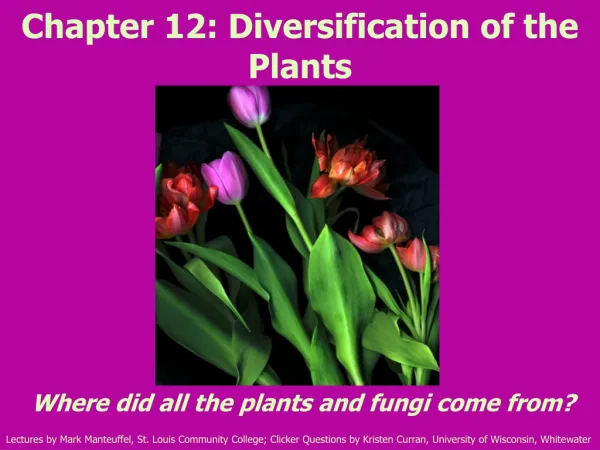
Chapter 12: Diversification of the Plants Where did all the plants and fungi come from? Lectures by Mark Manteuffel, St. Louis Community College; Clicker Questions by Kristen Curran, University of Wisconsin, Whitewater
4 Major Plant Phyla Bryophytes
12.2 Colonizing land brings new opportunities and challenges for plants.
A life cycle of alternating haploid and diploid generations in which the diploid embryo is protected by the haploid female
12.3 Mosses and other non-vascular plants lack vessels for transporting nutrients and water. The Bryophytes include: mosses, liverworts, and hornworts
12.4 The evolution of vascular tissue made larger plants possible. Like a circulatory system, vessels are an effective way to carry water and nutrients up from the soil to the leaves.
Now the sporophyte generation (diploid adult) dominates: is more conspicuous, is present for a longer period of time in the life cycle, and is responsible for photosynthesis.
12.6 With the evolution of the seed, gymnosperms became the dominant plants on Earth.
Now the sporophyte generation is even more dominant. The gametophytes are smaller but are still multicellular.
95 % of the world’s plants are Angiosperms, which diversified with the mass extinction of the dinosaurs.
Angiosperm reproduction more closely resembles the life cycle of animals: a diploid adult and haploid gametes.
12.11 Fleshy fruits are bribes that flowering plants pay animals to disperse seeds.
Monocot • Grains (wheat, corn, rice, millet), lilies, daffodils, sugarcane, banana, palm, ginger, onions, bamboo, sugar, cone, palm tree, banana tree, and grass are examples of plants that are monocots.
Dicot • Legumes (pea, beans, lentils, peanuts), daisies, mint, lettuce, tomato and oak are examples of dicots.