Discovering Hot Jupiters: Insights into Extra-Solar Planet Populations
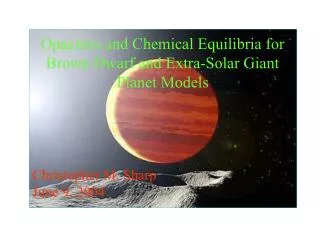
The search for extra-solar planets began with the landmark discovery of the first "Hot Jupiter" around 51 Pegasi in 1995. This discovery, facilitated by measuring star velocities through the Doppler shift of spectral lines, opened the door to new planetary systems. As of November 2012, over 850 planets were confirmed outside our solar system, predominantly gas giants. These findings raise questions about the existence of Earth-like planets and the conditions necessary for life, especially within habitable zones around stars. Upcoming experiments aim to locate smaller, rocky planets in these zones.

Discovering Hot Jupiters: Insights into Extra-Solar Planet Populations
E N D
Presentation Transcript
Extra-Solar Planet Populations George Lebo 10 April 2012 AST 2037 1
Radial Velocity Planet Searches • So … need a speedometer to measure star velocity versus time • To a precision of a few meters per second! • Across distances of many light years!!! • How? Doppler shift of spectral lines 2
51 Pegasi • In 1995, Mayor & Queloz announce the discovery of an orbital signature with amplitude = 50 m/s in a 4.23-day period around star 51 Pegasi • Mass = 0.5 MJUP First extra-solar planet 3
51 Pegasi: Hot Jupiter? • At that location, expected temperature is VERY high (about 2000K or higher!) • So … Jupiter-like planet, but closer than Mercury “Hot Jupiter” • How do you make something like that???? 4
Planet Bonanza • Geoff Marcy & Paul Butler quickly confirmed 51 Pegasi • They had lots of archival data from searches for Jupiter-type planets (periods >10 years, so they were still “in progress”) • No one even thought to look for short-period MASSIVE planets (why would they be easier?) • Found many “Hot Jupiters” – most extra-solar planets known today are Hot Jupters 5
ES-Planet Population • As of November 19, 2012, 851 planets are known to orbit other stars in 670 Planetary Systems(!!) • All of this has happened in about 20 years – someone currently finds a new planet every day • These planets are NOT generally like our Solar System objects – WHY? 6
Planets found so far • Note velocity limits • No Earths so far – why? 7
Upsilon Andromedae • First multiple planet system 13
Upsilon AndromedaeA Four-Planet System as of 11/19/12All Jupiter-Size • First multiple planet system 14
HD 209458 • Another Hot Jupiter, a = 0.045 AU 15
HD 209458 • What is a “transit”? 16
HD 209458 • A transit observed • Note: only ~1% dip 17
HD 209458 - Results • Just at the entry moment into transit, for a brief instant, only the upper atmosphere of the planet absorbs any starlight • With a powerful enough spectrograph, we can look for absorption lines at this instant • Result: COMPOSITION of the planet atmosphere • HD 20948b contains – WATER!! 18
Gliese 581c • Low-mass planet, with mass 5 Mearth • Orbit semi-major axis 0.07 AU • Low-mass star 21
Planets in Habitable Zones • Several planets are currently known in the Habitable Zone around their parent stars • All of these are gas giants no solid surface • But … gas giants in our Solar System have lots of moons • What happens to Europa if you move it/Jupiter to a distance of 1 AU? 22
Planets in Habitable Zones • What happens to Europa if you move it/Jupiter to a distance of 1 AU? • Really? • Europa mass is closer to our moon’s mass – why no water there? • So … need giant planets in the HZ with giant moons … 23
Planets in Habitable Zones • We don’t see any Earth-mass planets in the HZ • Does this mean they do not exist? 24
Planets in Habitable Zones • Future experiments will use other techniques than Doppler shifts to search for planets • These will have the sensitivity to look for Earth-mass planets in the HZ • Stay tuned! 25
Terrestrial Planet Finder Cancelled, 2011 • Ultra-high-contrast imager satellite • Capable of finding Earth-mass planets in HZ around nearby stars 26
Kepler 22-b, First Earth-Sized Planet in the Habitable Zone of a Sun-Like Star, May 2012
Summary • We have found hundreds of planets around other stars • Overwhelming majority are massive gas giants, many close to their parent star • This is because they are easiest to find with the Doppler technique • Have found: multiple planet systems (20+); planet atmospheres; some low-mass (probably solid) planets • Eccentricity seems more common than circular orbits; problems for life • So far, only a few gas giants in the HZ; no solid planets; maybe moons could host life (??) • Future searches will be sensitive to Earth-mass planets in the HZ 28