Exploring the Virtue of Care: Balancing Personal and Community Needs
This text delves into the concept of care as a foundational virtue, drawing upon various philosophical perspectives, including Aristotelian virtues, Christian values, and Confucian principles. It emphasizes the importance of empathy and moral attention in fostering caring communities. The discussion highlights the interplay between care, justice, and moral development, while addressing potential failures in empathy and the impact of societal values on care work. Additionally, the text explores the implications of feminism in care practices, advocating for a compassionate response to the needs of all individuals within communities.

Exploring the Virtue of Care: Balancing Personal and Community Needs
E N D
Presentation Transcript
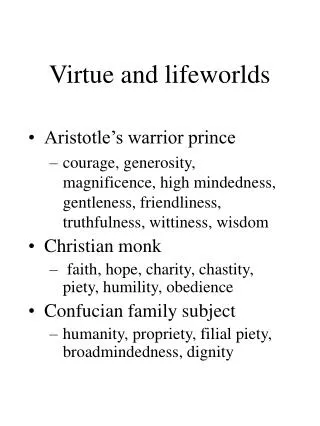
Virtue and lifeworlds • Aristotle’s warrior prince • courage, generosity, magnificence, high mindedness, gentleness, friendliness, truthfulness, wittiness, wisdom • Christian monk • faith, hope, charity, chastity, piety, humility, obedience • Confucian family subject • humanity, propriety, filial piety, broadmindedness, dignity
The world of the market • The competitive individualist • Disciplined, hard working, entrepreneurial, organized, driven to succeed
The Caring Community • Humans are essentially social creatures. • Doing the right thing means creating and sustaining caring communities. • Care is a basic human capacity to recognize and respond to the needs of others. • Care begins at home and extends to distant others.
Empathy and Care • Empathy is basic human capacity • Must be developed through • past care • caring interactions with others • Commitment to be a caring person
Care as Virtue • Care as foundational virtue • Disposition to be good friend, family member and citizen of caring community • Care is a disposition to respond to others by • Not inflicting harm • Alleviating suffering • Cultivating caring communities • Requires the cultivation of empathy and its extension to distant others
Central features of care • Moral attention • attention to the facts • Sympathetic understanding • awareness of what the other would want you to do, and of what would be best for the other. • Relationship awareness • awareness of existing relationships, of need to create and sustain community • Accommodation and harmony • Balancing interests and preserving harmony in so far as you can.
Failures of Empathy • Deliberate blunting of feeling of empathy: e.g. blaming the victim • Here and now bias • Empathic over-arousal
Failure to Develop Empathy • “can be destroyed by power-assertive childrearing, diminished by cultural valuing of competition over helping others, and overwhelmed by egoistic motives… nonnurturant, excessively power-assertive life experiences may well produce individuals who cannot empathize.” (M. Hoffman, Empathy and Moral Development 281-2)
Responding to Failures of Empathy • In oneself: • Call up feeling of empathy • e.g. by imagination • In Society and family • Share care work • Sensitive childrearing • Emphasize helping over competition • Limit “power-assertive life experiences”
“Care and Justice voices”: Moral reasoning • Care: moral development as emotional maturity. • Justice: moral development as cognitive. • Care: moral reasoning is contextual. • Justice: moral reasoning is finding the right principles to apply to each case.
“Care voice”: persons • The caring community • Embedded persons • Particular social context • Some relationships are given. • Connected selves • Self-understanding in terms of relations with others.
“Justice voice”: persons • The world of the market • Autonomous individuals • Capable of self-definition in all social contexts. • Relationships are contractual. • Separate/Objective Self • Self-understanding in terms of individual characteristics and desires.
Care and other Moral Perspectives • Different perspectives reveal different aspects. • Care as practice and care as moral perspective
What to do? • Direct your moral attention to others. • Be open to sympathetic understanding. • Be aware of the need to sustain and preserve networks of care. • Try to preserve harmony. • Short cut: What would my ideal caring self do?
Feminism and Care • Taking the experiences of women and girls seriously. • Autonomy and its limits • Who is doing “care” work? • In the household • Domestic work • Emotional work • In the larger society • Who loses when care work is limited in these ways?