Understanding the Z-Scheme: The Role of PSII and PSI in Photosynthesis
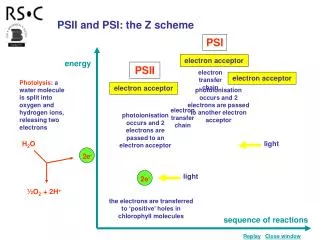
This overview of the Z-scheme delineates the roles of Photosystem II (PSII) and Photosystem I (PSI) in the light-dependent reactions of photosynthesis. The process begins with photolysis, where water molecules are split into oxygen and hydrogen ions, releasing electrons that travel through the electron transfer chain. Photoinization activates electron movement to acceptors, facilitating the sequential transfer of energy. This process ultimately transforms light energy into chemical energy, essential for plant metabolism.

Understanding the Z-Scheme: The Role of PSII and PSI in Photosynthesis
E N D
Presentation Transcript
light light 2e- PSII and PSI: the Z scheme PSI electron acceptor energy PSII electron transfer chain electron acceptor Photolysis: a water molecule is split into oxygen and hydrogen ions, releasing two electrons electron acceptor photoionisation occurs and 2 electrons are passed to another electron acceptor electron transfer chain photoionisation occurs and 2 electrons are passed to an electron acceptor H2O 2e- ½O2 + 2H+ the electrons are transferred to ‘positive’ holes in chlorophyll molecules sequence of reactions ReplayClose window


![Blue-Colored Donor-Acceptor [2]Rotaxane](https://cdn1.slideserve.com/2419410/blue-colored-donor-acceptor-2-rotaxane-dt.jpg)