Understanding Urban Environments: Growth, Patterns, and Global Trends
Urban environments are complex areas characterized by high population density and human-made structures. This project examines the notion of urbanization, exploring how it manifests in different parts of the world. We analyze statistics from sources like UN and WHO about population growth in cities, visualize data through maps of the largest urban areas, and discuss qualitative and quantitative differences in urban settings. The goal is to understand why urbanization occurs, and the implications it has on society and the environment.


Understanding Urban Environments: Growth, Patterns, and Global Trends
E N D
Presentation Transcript
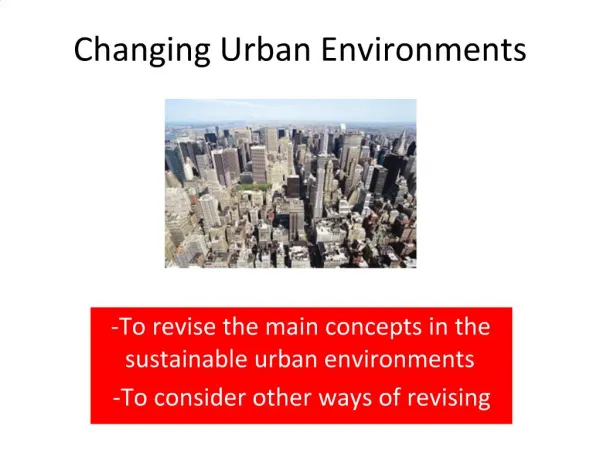
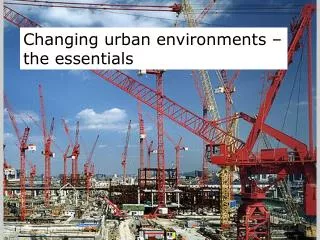
Option G Urban Environments Find an image to represent an urban environment Explain why you’ve chosen it
What is an urban area? • http://unstats.un.org/unsd/demographic/sconcerns/densurb/Defintion_of%20Urban.pdf • Identify similarities and differences • Which are qualitative / quantitative?
Brainstorm these keywords! • Urbanisation • Urban sprawl • Suburb • Suburbanisation • Counter-urbanisation • Re-urbanisation
World’s largest cities? • Can be measured by the municipality – the legal city • Can be measured by the physical city – the built up portion • Can be measured by it’s influence – how far do people commute? • http://www.bbc.co.uk/news/magazine-16761784
In 2005 Time Magazine proclaimed Chongqing the largest city in the world However, 30 million of those living in Chongqing are actually agricultural workers living in a rural setting
Top 20 cities 2012 • http://www.worldatlas.com/citypops.htm#.UnYgIvlBOSo • Create a google map with the top 20 cities in 2012 • Paste it into a document • Annotate your map: • Do you notice any patterns? • Can you explain these patterns?
Growing urban populations • For the first time ever, the majority of the world's population lives in a city. • One hundred years ago, 2 out of every 10 people lived in an urban area. • By 1990, less than 40% of the global population lived in a city, but as of 2010, more than half of all people live in an urban area. http://www.who.int/
By 2030, 6 out of every 10 people will live in a city, and by 2050, this proportion will increase to 7 out of 10 people. • Currently, around half of all urban dwellers live in cities with between 100 000 - 500 000 people. • Fewer than 10% of urban dwellers live in megacities (defined by UN HABITAT as a city with a population of more than 10 million). • http://www.who.int/gho/urban_health/situation_trends/urban_population_growth_text/en/
10 biggest cities in 1900. How does this compare to now? • London, United Kingdom 6,480,000 people • New York, United States 4,242,000 people • Paris, France 3,330,000 people • Berlin, Germany 2,707,000 people • Chicago, United States 1,717,000 people • Vienna, Austria 1,698,000 people • Tokyo, Japan 1,497,000 people • St. Petersburg, Russia 1,439,000 people • Manchester, United Kingdom 1,435,000 people • Philadelphia, United States 1,418,000 people
http://news.bbc.co.uk/2/shared/spl/hi/world/06/urbanisation/html/urbanisation.stmhttp://news.bbc.co.uk/2/shared/spl/hi/world/06/urbanisation/html/urbanisation.stm TASK:Complete this table using the link above
Urban growth rates • Suggest some reasons for the patterns and trends
Most urbanised continents are Europe, North America, South America Oceania (the ‘developed’ world). • However, there are more urban dwellers in Asia (40% of population=1.4 billion) • Also urbanisation is most rapidly increasing in Africa and Asia. By 2025 almost half the population of them will live in urban areas and 80% of all urban dwellers will live in developing countries. • So , although MEDCs have more cities, more people actually live in cities in the developing world and this is continuing to rise. What are the reasons for this?
task • Define these key words; • Millionaire cities • Megacities • World cities .
To finish • Now look back at your image. • What annotations could you add to it using the information from today’s lesson?