Mitosis Objectives
Mitosis is a vital process in the cell cycle where a single cell divides to form two identical daughter cells, each with the same number of chromosomes. This educational overview explains the stages of mitosis, including interphase, prophase, metaphase, anaphase, and telophase, highlighting key events such as chromosome duplication, alignment, and separation. Additionally, cytokinesis, the final step of cell division, is addressed, illustrating how the cytoplasm divides to complete the process. Understanding mitosis is essential for grasping fundamental biological concepts.

Mitosis Objectives
E N D
Presentation Transcript
Mitosis Objectives • Explain how cells produce more cells • Describe the process of mitosis
Vocabulary • cell cycle-the life cycle of a cell • chromosome- two DNA molecules held together by a centromere • homologous chromosomes- similar chromosomes (46 in human body) • mitosis- the process of chromosome separation • Cytokinesis- the division of cytoplasm to form two daughter cells
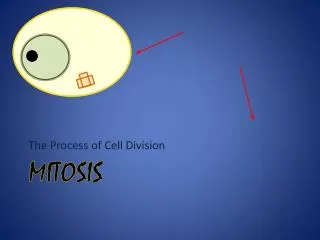
What is it? • The process of cell division that forms two new nuclei, each of which has the same number of chromosomes
Copying DNA (Interphase) • Before mitosis begins, chromosomes are copied • Each chromosome is then two chromatids
Phase I: Prophase • Nuclear membrane dissolves • Chromosomes condense into rodlike structures • Centrioles move to opposite ends of the cell and spindle fibers stretch across the cell
Phase II: Metaphase • Chromosomes line up along the equator of the cell • Homologous chromosomes pair up
Phase III: Anaphase • The chromatids (after each chromosome is duplicated, the two copies are called this)separate and move to opposite sides of the cell
Phase IV: Telephase • A nuclear membrane forms around each set of chromosomes • The chromosomes unwind • Mitosis is complete
Cytokinesis • In cells that lack a cell wall, the cell pinches in two. • In cells that have a cell wall, a cell plate forms between the two new cells.