Advancements in Sarcoma Research: French Sarcoma Group Overview (2004)
150 likes | 293 Vues
The French Sarcoma Group, established by FNCLCC in the 1980s, coordinates clinical research across 37 institutions to improve patient care. With a focus on education, basic and clinical research, and intergroup collaborations, the group has developed a comprehensive soft tissue sarcoma database, documenting over 2,500 cases. Key studies include various phase II and III trials for sarcomas and collaborations with EORTC. Ongoing efforts aim to advance diagnostic techniques and chemotherapy responses, enhancing treatment protocols for sarcomas and ensuring better patient outcomes.


Advancements in Sarcoma Research: French Sarcoma Group Overview (2004)
E N D
Presentation Transcript
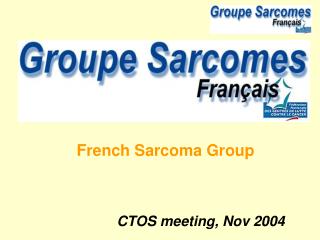
CTOS meeting, Nov 2004 French Sarcoma Group
FNCLCC Sarcoma Group • Started from a multicentric work of pathologists since 1980’s (JM Coindre) FNCLCC grading • Established in 1980’s by the FNCLCC to coordinate clinical research on sarcomas among the 20 french cancer centers (BN Bui). • Open to other public and private structures treating cancer patients since 2000 : French Sarcoma Group • 2004 : n=37 institutions • (comprehensive cancer ctrs, Univ. Hospitals, private clinics... + CHUV Lausanne)
FNCLCC Lille Rouen Paris (Curie, IGR, St-Cloud) Nancy Caen Reims Strasbourg Rennes Angers Nantes Dijon Clermont- Ferrand Lyon Bordeaux Nice Toulouse Marseille Montpellier
French Sarcoma GroupObjectives • Education and improvement of the quality of patient care • Basic, translational and clinical research • Intergroup collaborations (EORTC…)
Pathology(coord. : J.M .Coindre) FNCLCC soft tissue sarcoma database (2500 patients 1985 2004) • all pathologies collegially reviewed monthly • Patient recorded from initial diagnosis • all cases documented with patients and tumors characteristics, treatment data and evolution • FNCLCC Grading Frozen tissue bank (1000 sarcomas, 300 benign tumors) • to allow diagnostic and prognostic studies on homogenous groups by tumor types or localizations
Molecular biology(coord. : A. Aurias) Chromosomal and genomic abnormalities of sarcomas • Diagnostic and prognosis of sarcomas (eg : MFH and undifferentiated sarc) (A. Aurias) • Arraying of STS to define new entities and molecular pathways (A. Aurias) • Gene expression and response to chemotherapy (J. Robert)
Clinical trials(JY Blay, A. Le Cesne, BN Bui) Soft tissue sarcomas • PAC 02 : phase III study of intensification after remission induction in advanced STS (Palsar II) (BN Bui); n=127 • Randomized phase II study of dose reduction (0.5 vs 1 vs 2 vs 4 mg) of TNF in isolated limb perfusion (S.Bonvalot); n=102 • A phase II trial of imatinib in locally advanced non resectable aggressive fibromatosis (JY Blay); n=9 • A phase II trial of weekly paclitaxel in advanced angiosarcomas (N Penel)
Visceral sarcomas Uterine sarcomas • A prospective randomized phase II trial of Surgery+RT vs Surgery +APIx3+ RT in high grade uterine sarcomas (P. Pautier); n=34 • A prospective randomized phase II trial of Gemcitabin vs Gemcitabine + docetaxel in relapsed uterine sarcomas (F. Duffaud & P. Pautier)
Visceral sarcomas GIST: • BFR14 prospective phase III trial testing Glivec maintenance vs interuption after 3 years (Blay & Le Cesne) • Participation to the EORTC 62024 adjuvant imatinib trial in GIST (P. Casali) • Phase II trials of a new KIT inhibitor AB1010 in front line and in imatinib refractory patients (Le Cesne & Blay)
Clinical trials Soft tissue sarcomas : future studies • A prospective randomized phase III trial of Surgery+EBRT vs Surgery alone in retroperitoneal sarcomas (C.Le Péchoux) • A prospective randomized phase III trial of Surgery+EBRT vs Surgery alone in limb sarcomas R0 margins>1 cm
Bone sarcomas: clinical trials Ewing sarcoma • PAC 01 : protocol Euro-E.W.I.N.G 99 (with SFOP, UKCCSG, SIAK, GPOH) (O. Oberlin) • Phase II trial of CDDP + VP16 in relapsed ES/PNET (O. Oberlin)
Bone sarcomas: clinical trials Osteosarcoma • OSAD 1993. Phase II of IP as induction chemotherapy in localized osteosarcomas (JY Blay) • OSAD 2000 (PAC 04). Phase II of API-AI as induction chemotherapy (A. Le Cesne) • Followed by: A prospective randomized phase III trial testing HDCT in poor histological responders to preoperative regimen in first line treatment of osteosarcomas (with SFOP)
Education and improvement of primary care • CME for the management of the pathology of STS since 1980’s • Pathology review since 1989 • Internet presentation of clinical cases • CME in different french regions through cancer networks • Clinical practice guidelines (SOR project) (Br J Cancer, Bull Cancer, www.fnclcc.fr...)
FNCLCC S.O.R. Project • Guidelines for the management of patients with cancer at the first treatment. • SOR for osteosarcomas and adult soft tissue sarcomas - First issue in 1995 (Bull Cancer 1995) - Updates: osteosarcoma (1999, Br J Cancer), adult STS (2004) • Retrospective and prospective evaluation of the adhesion to CPGs in regional cancer Network (Ann Oncol 2004)
Conclusions: FSG • Clinical and Public Health research • Education • Intergroup studies